
01
Connect Everything
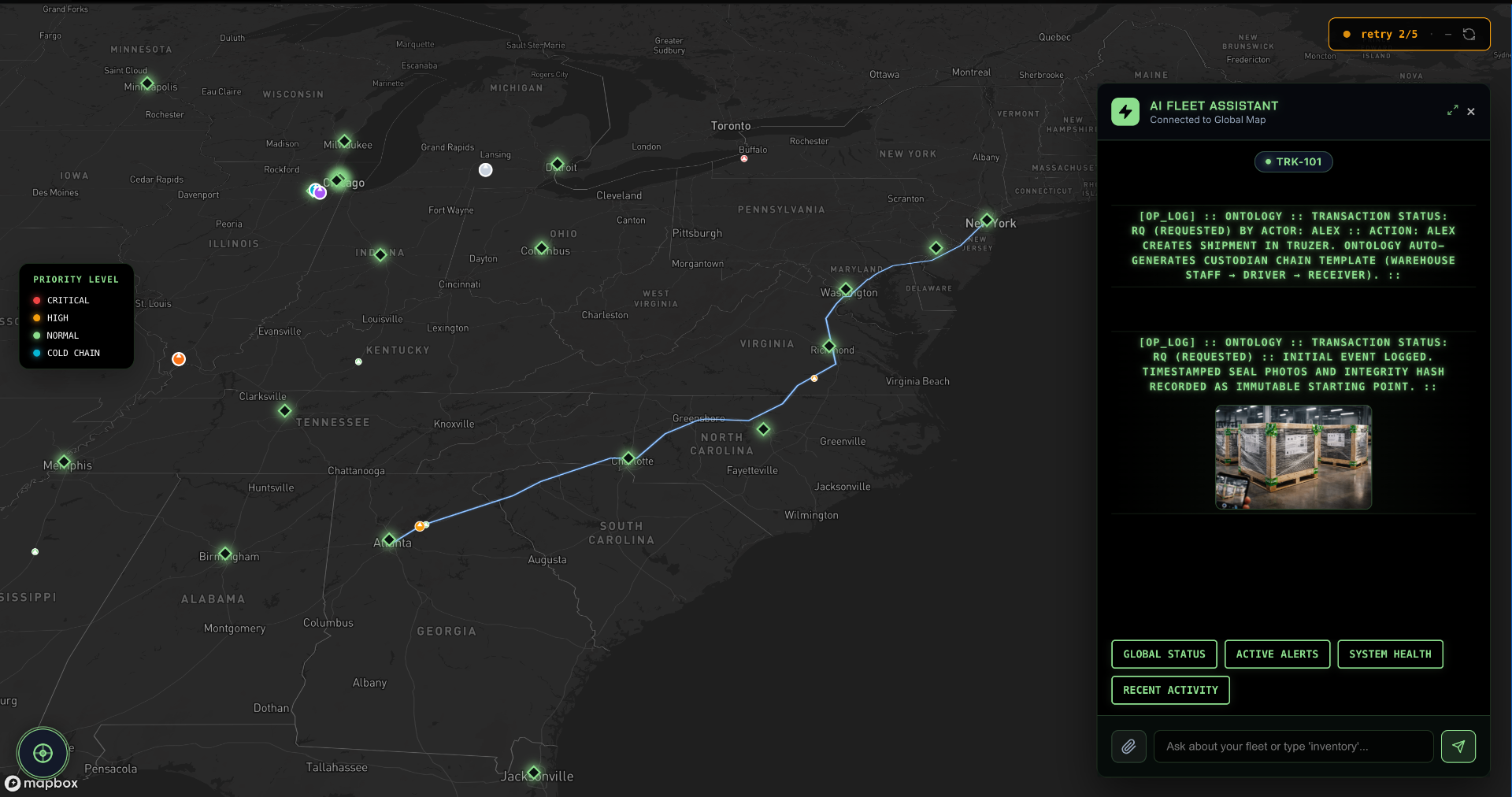
Your TMS, ERP, telematics, IoT, EDI. All of it. Truzer aggregates the complex and maps it into a single unified ontology. No rip-and-replace. No 18-month implementation. Your systems keep running.
AI for claims processing built for TPAs, carriers, and self-insured operators. Every output cites the clause, the file, and the page it came from. When the regulator asks why, the answer replays. No black box. No bolt-on.
AI for claims processing is the use of AI models grounded in policy documents and claim files to read, validate, and adjudicate insurance claims without manual re-keying. It applies to every stage of the claim, from First Notice of Loss through reserve, decision, and payout. The platform reads policy declarations, medical records, attorney letters, EDI 837 transactions, and damage photos. Each extracted field ties back to the page region it came from, and each decision cites the policy clause behind it. Validation runs at the source, so hallucinated coverage and policy-language mismatches are caught before a claim moves. Every model output, version, and decision step is logged in a replayable, time-stamped record.
What does AI do in claims processing?
A modern AI for claims processing platform handles the full FNOL-to-decision lifecycle:
Truzer is AI for claims processing that grounds every output in the policy language and the source documents behind the decision. The audit trail is replayable, not reconstructed.

Craig and Michael have spent 10+ years aggregating the complex for 1,000+ organizations. In insurance, AI shows up as pilots that never reach production, models that hallucinate policy language, and audit trails the regulator can't replay. Truzer.ai is what they built so the operators carrying that risk every quarter stop pretending the AI is grounded in something.
Book a Founder Call




Built for TPAs, carriers, and self-insured operators running insurance claims automation at scale. Sits on top of Guidewire, Duck Creek, or your existing system.
Every AI output cites the policy clause, claim file, or page region it came from. The model retrieves before it generates, so the answer is in the policy.
Hallucinated coverage, missing endorsements, and policy-language mismatches get flagged before a claim moves to a decision. AI cross-checks every output against the policy and the claim file in real time. Bad data gets caught before the regulator does.
Every claim, every model output, every SLA clock on one control tower. FNOL, triage, adjudication, and SIU share a single live view. The answer to “why did the AI flag this?” is the same for everyone.
Every model version, input, and decision step is timestamped and source-tagged in real time, replayable for the examiner. Events land in Truzer's ontology, a live digital twin of every claim. Explainability lives in the architecture, where the regulator can find it.
Two ways to run AI for claims in 2026. One of them is still in pilot.
Production readiness
Grounding
Stack fit
Replayability
Adjuster adoption
Deployment
Commitment
Every business we’ve transformed over the past decade was inflicted with the same limitations. Here’s how we fix yours.
Your TMS, ERP, telematics, IoT, EDI. All of it. Truzer aggregates the complex and maps it into a single unified ontology. No rip-and-replace. No 18-month implementation. Your systems keep running.
Right away you’re immersed into a complete visual experience. Seeing everything in real time. Your whole operation, stupidly visible. Not yesterday’s report. Not a dashboard silo. The truth, live, now.
The ontology doesn’t just show your data. It maps how every asset, route, team, customer, and regulation connects to each other. When one thing changes, you already know what it affects. All truth. No fiction.
AI agents monitor your operation 24/7. They flag exceptions, lock down compliance violations, send proactive customer updates, and surface revenue opportunities. Grounded in your ontology. Not hallucinated from generic training data.
Yes. AI is used at every stage of claims processing, from First Notice of Loss through reserve, decision, and payout. The model reads policy declarations, medical records, attorney letters, EDI 837 transactions, and damage photos, then validates coverage and drafts decisions grounded in the source. Sedgwick's 2026 report found 58–82% of insurers use AI; only 7% have scaled it. The version that graduates is grounded, validated at the source, and audit-logged.
AI is used in claims management for document extraction, policy validation, fraud and risk scoring, adjuster routing, adjudication support, and audit-trail logging. The model reads the claim file, cross-checks coverage against the policy, flags pattern and timing anomalies for SIU, routes by severity, cites the policy clause behind every reserve, and timestamps each decision step. The result is faster cycle time, fewer denials in dispute, and an audit trail the examiner can replay.
Hallucinations get prevented by retrieving before generating. The model pulls the actual policy clause, endorsement, or claim file passage and grounds its output in that source. Every AI decision cites the page region it came from, so a reviewer can verify the citation in one click. If the model can't find a grounded source, the claim routes to a human instead of guessing. Validation runs at the source, so policy-language mismatches surface before adjudication.
The audit trail is replayable in real time. Every input, model version, prompt, retrieved source, and decision step is timestamped and source-tagged as the claim moves. When a regulator or examiner asks why, the operator opens the claim's audit view, sees the policy clauses cited, the AI decision rationale, and the human reviewers who signed off. NAIC Model Bulletin disclosure requirements are met by the architecture, not by a binder.
Adjusters keep authority and gain capacity. AI handles the document reading, policy lookup, and rule checks, then surfaces the inputs and citations the adjuster needs to make the call. Industry research from Wisedocs found only 16% of adjusters trust AI without seeing the source. Truzer is built so they see every source. Capacity goes up because the rote work is gone, and authority stays with the adjuster who signs the decision.
Book a call with Craig and Michael. See your own claims, your own AI decisions, and your own audit trail running on Truzer.