
01
Connect Everything
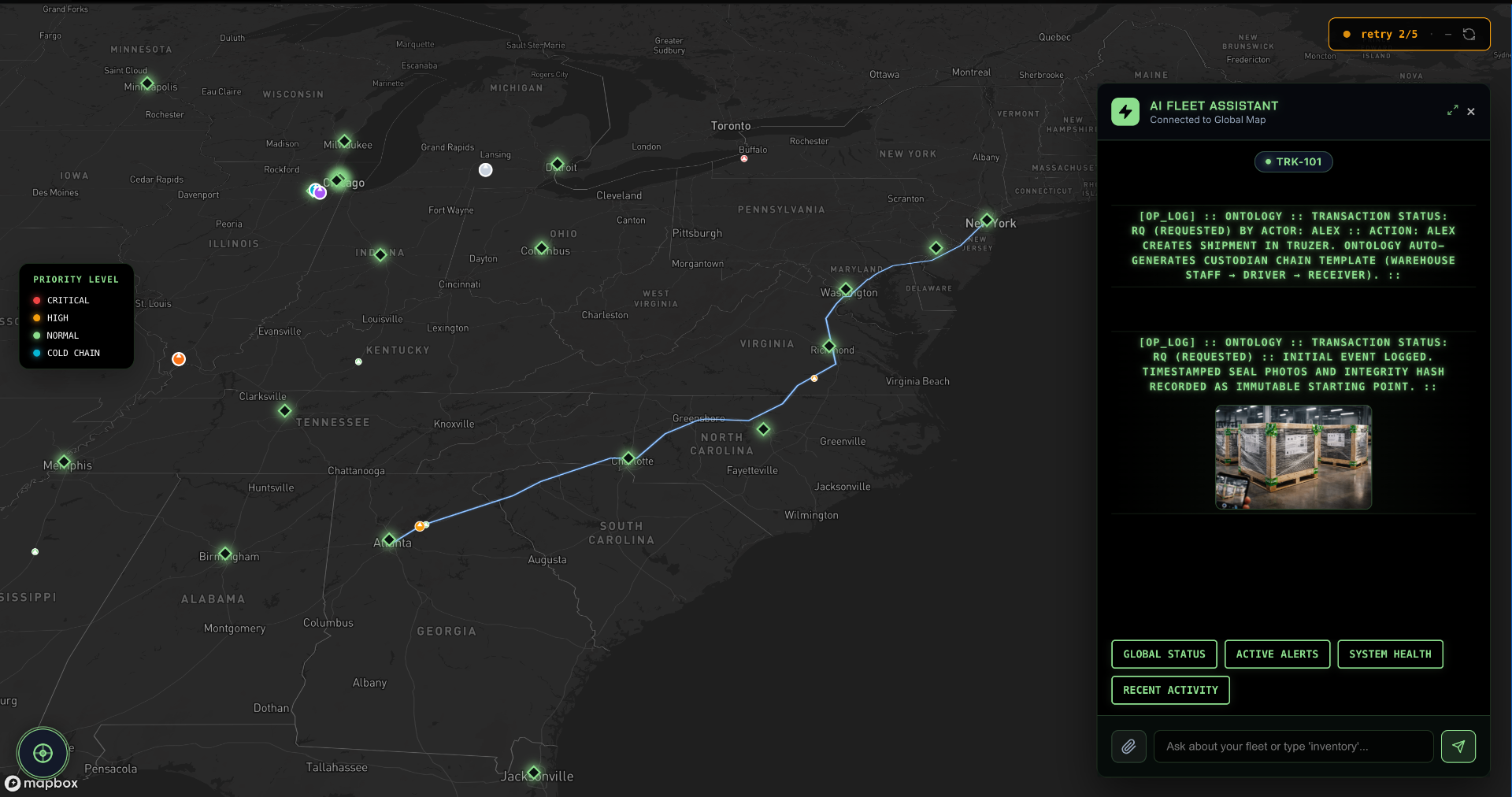
Your TMS, ERP, telematics, IoT, EDI. All of it. Truzer aggregates the complex and maps it into a single unified ontology. No rip-and-replace. No 18-month implementation. Your systems keep running.
AI for insurance claims built for TPAs, carriers, and self-insured operators. The loss-ratio impact every CFO needs to attribute, the audit artifact every regulator will ask for, and the adjuster authority no plaintiff can challenge. No black box. No bolt-on.
AI for insurance claims is the use of AI models inside the claims operation to read claim files, validate coverage, score fraud, and route adjudication so the program shows up on the underlying combined ratio. It applies across FNOL intake, damage assessment, fraud detection, document review, and policyholder communication. The mechanism is straightforward: efficiency gains route to loss adjustment expense, recovery yields lift subrogation and SIU income, and the audit artifact holds to NAIC Model Bulletin standards. Mature deployments embed AI into the operating model rather than running it as a side initiative. The CFO attributes the combined-ratio movement, the regulator gets a defensible audit, and the adjuster keeps final authority on every adjudication.
What insurance outcomes does AI improve?
A modern AI for insurance claims program improves the metrics the CFO and the regulator both ask about:
Truzer is AI for insurance claims grounded in your policy language, your claim file, and your ontology, the live digital twin of every claim. One source for the loss-ratio attribution. One source for the regulator’s audit. One source for the adjuster’s authority.

Craig and Michael spent 10+ years aggregating the complex for 1,000+ organizations. The pattern is the same in every industry: AI without a data foundation books dashboard wins and never reaches the financial statement. Truzer.ai is what they built so that stops happening in insurance claims.
Book a Founder Call




Built for TPAs, carriers, and self-insured operators running AI for claims processing at scale. Sits on top of Guidewire, Duck Creek, or your existing system.
Every AI output ties to the policy clause and the claim file behind it, so LAE compression and indemnity impact show up on the underlying combined ratio. The CFO can read the program in basis points the underwriting team will defend.
AI sits inside your data, your platforms, and your analytics. Underwriting discipline, claims, fraud, and subrogation read from the same source layer. The program compounds across lines instead of running as a side experiment.
Every claim, every reserve, every SIU flag, every subrogation file on one control tower. FNOL volume, cycle time, leakage, and recovery yield share a single live view. The metric the CFO defends is the metric the team operates against.
Every decision, with named human authority, time-stamped against the source clause and the model version. Events land in Truzer's ontology, a live digital twin of every claim. The audit artifact is ready before the regulator asks. And before the plaintiff does.
Two ways to run AI for insurance claims. One of them never lands on the loss ratio.
Financial impact
Operating model
Adjuster adoption
Defensibility
Recovery
Deployment
Commitment
A quarter from now, your AI is either booked on the combined ratio or still booked on the dashboard.
Every business we’ve transformed over the past decade was inflicted with the same limitations. Here’s how we fix yours.
Your TMS, ERP, telematics, IoT, EDI. All of it. Truzer aggregates the complex and maps it into a single unified ontology. No rip-and-replace. No 18-month implementation. Your systems keep running.
Right away you’re immersed into a complete visual experience. Seeing everything in real time. Your whole operation, stupidly visible. Not yesterday’s report. Not a dashboard silo. The truth, live, now.
The ontology doesn’t just show your data. It maps how every asset, route, team, customer, and regulation connects to each other. When one thing changes, you already know what it affects. All truth. No fiction.
AI agents monitor your operation 24/7. They flag exceptions, lock down compliance violations, send proactive customer updates, and surface revenue opportunities. Grounded in your ontology. Not hallucinated from generic training data.
Yes. Between 58% and 82% of insurers use AI in claims operations, but only 12% report mature AI and only 7% have scaled it, per Sedgwick's 2026 “Future-Ready Property Claims” report. Travelers' Q4 2025 update: more than half of all claims are eligible for straight-through processing, and call center headcount is down a third. Liberty Mutual reports a 10-point combined-ratio improvement since 2021, attributed to AI embedded into platforms, data, and analytics. Adoption is broad. Maturity is rare. The question is which side of the 7% line the program lands on.
The best AI for insurance claims is the one whose outputs land on the underlying combined ratio, whose audit holds up to NAIC Model Bulletin standards, and whose adjudication ties to a named human in final authority. Demo accuracy is not the scoring dimension. Loss-ratio attribution is. The buyer's checklist: Does it produce LAE basis points the CFO can defend? Is it embedded into the operating model? Is every adjudication signed by a human? Is the audit ready before the regulator asks? Truzer's AI for claims processing was built to answer yes on all four.
No. The mature deployments use AI to expand adjuster capacity, not replace the adjuster. MSIG USA's chief claims officer Ron Morrison: “Once AI is totally instilled, supervisors will have twice as much capacity.” CorVel's Ryan Murphy: “The focus is not on replacing claim professionals, but on enhancing how they work.” The economics depend on the adjuster staying in final authority. Without a named human accountable, the audit trail collapses under regulatory scrutiny, per Zelle LLP's Lokken analysis. The job changes. Rote work compresses. Judgment and authority stay with the adjuster.
Only if the audit trail names a human in final authority on every adjudication. Zelle LLP on the Lokken case: “The more an adjuster's role looks like confirming an AI recommendation, the more a plaintiff may argue the carrier failed to conduct a reasonable, claim-specific evaluation.” The defensible structure is documented human review, time-stamped against the source clause and model version, with the adjuster's reasoning captured separately. The NAIC Model Bulletin frames the same standard. Truzer's audit artifact is built to that frame.
AI reduces claims leakage by validating coverage against policy language, surfacing missing endorsements, and flagging severity outliers before they book against incurred. The leakage that compounds in basis points comes from fragmented data. Five vendors, five silos, and no shared source for the claim. Sedgwick's 2026 report: “Different carriers specialize in different lines, and there's just so much complexity across the insurance space.” The fix is one control tower across FNOL, triage, fraud, and subrogation, grounded in your policy language and your claim file.
Move the combined ratio. Defend the audit. Keep the adjuster in authority.