
01
Connect Everything
Your TMS, ERP, telematics, IoT, EDI. All of it. Truzer aggregates the complex and maps it into a single unified ontology. No rip-and-replace. No 18-month implementation. Your systems keep running.
Driver Qualification File automation built for Fleet Safety Managers, Compliance Directors, and VPs of Operations under FMCSA audit pressure. Every Med Card, MVR, and Clearinghouse query tracked over SMS, validated against the state registry, and logged before anyone asks. No spreadsheet hell. No surprise downgrades.
A driver qualification file, or DQF, is the federally mandated record every motor carrier keeps on every commercial driver under 49 CFR 391. It contains the documents that prove the driver is legally qualified to operate a commercial motor vehicle, including the employment application, motor vehicle record, road test certificate, medical examiner's certificate, and Clearinghouse query results. Some documents are collected once at hire, while others must be renewed every year and tracked against state-registry status. A missing or expired item in the DQF puts the driver out of service and exposes the carrier to FMCSA fines, conditional safety ratings, and post-loss litigation. The DQF is the difference between dispatching legally and dispatching blind.
What does a driver qualification file include?
A complete DQF carries six federally required document types, each with its own renewal cadence:
Truzer is the dispatch AI built around the ontology, an immutable audit trail of every DQF event, grounded in live state-registry data instead of the safety manager’s spreadsheet.

Craig and Michael have spent 10+ years aggregating the complex for 1,000+ organizations. In safety, the complex shows up as Med Cards expiring in a spreadsheet nobody reads, CDLs getting downgraded by the state without a single notification, and dispatchers assigning Friday loads to drivers whose MVR quietly expired three weeks ago. Truzer.ai is what they built so safety managers stop dispatching blind.
Book a Founder Call





Built for Fleet Safety Managers, Compliance Directors, and VPs of Operations running hazmat dispatch at scale. Sits on top of your existing TMS.
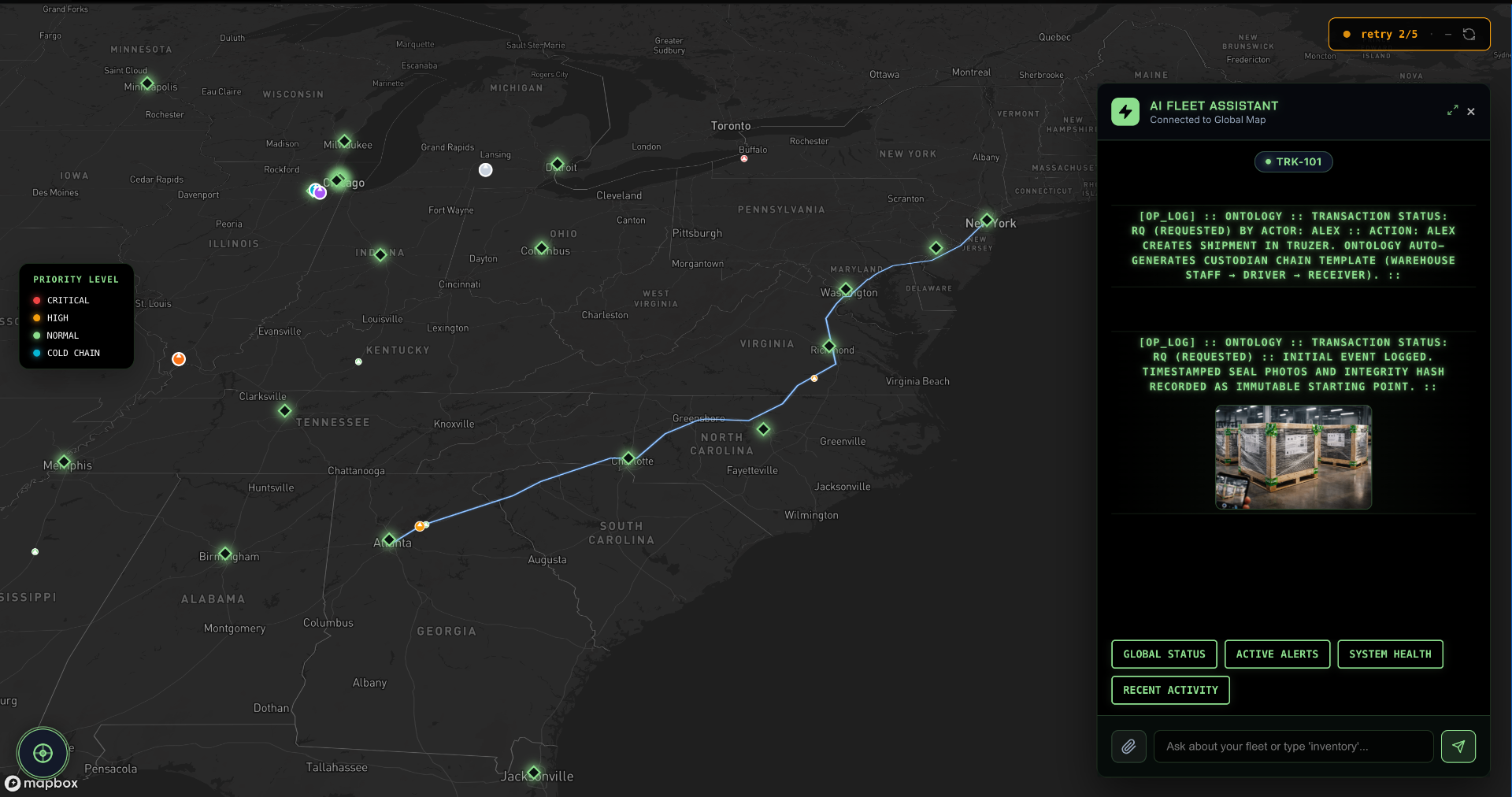
Pull every qualification document into one record per driver. HR application, MVR, road test certificate, Med Card, and Clearinghouse query results all land in the same ontology, tied to the same driver ID. The safety binder becomes the live state of the fleet.
The AI Bot texts every driver 30, 15, and 5 days before any document expires, with a mobile link to upload the new copy. No safety manager chasing Med Cards through email. No driver downloading another app to satisfy compliance.
The instant a Med Card expires or a CDL gets downgraded, the ontology severs the driver's eligibility inside the dispatch AI. The dispatcher physically cannot assign the load because the driver is no longer a valid asset. Overrides require admin clearance from Safety.
Every Med Card, every MVR pull, every Clearinghouse query is timestamped, source-tagged, and stored in Truzer's ontology, a live digital twin of the fleet's qualification status. When the FMCSA auditor arrives, the safety binder generates in one click. No scavenger hunt.
Two ways to manage driver qualification files.
Expiration tracking
State-registry sync
Driver follow-up
Data unification
Audit readiness
Deployment
Commitment
Every business we’ve transformed over the past decade was inflicted with the same limitations. Here’s how we fix yours.
Your TMS, ERP, telematics, IoT, EDI. All of it. Truzer aggregates the complex and maps it into a single unified ontology. No rip-and-replace. No 18-month implementation. Your systems keep running.
Right away you’re immersed into a complete visual experience. Seeing everything in real time. Your whole operation, stupidly visible. Not yesterday’s report. Not a dashboard silo. The truth, live, now.
The ontology doesn’t just show your data. It maps how every asset, route, team, customer, and regulation connects to each other. When one thing changes, you already know what it affects. All truth. No fiction.
AI agents monitor your operation 24/7. They flag exceptions, lock down compliance violations, send proactive customer updates, and surface revenue opportunities. Grounded in your ontology. Not hallucinated from generic training data.
A driver qualification file is built by the motor carrier rather than issued by a regulator. The carrier collects the documents required under 49 CFR 391 from the driver and third-party sources, then keeps them on file for the duration of employment plus three years after separation. The file includes the employment application, MVR, road test certificate, Med Card, and Clearinghouse query. Truzer builds and maintains it automatically, with every renewal tracked to the day.
The driver becomes ineligible inside the dispatch system at 12:01 AM. Truzer's ontology severs the relationship between the driver and the load pool the moment the Med Card crosses its expiration timestamp. The dispatcher cannot assign a load to that driver until a new Med Card is uploaded, parsed, and verified against the National Registry of Certified Medical Examiners. No email alert. No spreadsheet color change. The asset is gone until the document is current.
Yes. Truzer's AI Bot texts every driver 30 days, 15 days, and 5 days before any document expires. The text includes a mobile link to upload the new document directly from the cab. The AI Bot then parses the upload, validates it against the source registry, and writes the result to the DQF. Safety managers see the status in the control tower and only get involved on exceptions.
Yes. Truzer continuously cross-references uploaded documents against state-registry status across all 50 states. The moment a state downgrades a CDL because the driver did not file the Med Card with the DMV, the ontology flags the driver as out-of-service inside the dispatch system. The carrier sees the downgrade before the driver does and before the next weigh station does.
Yes. Truzer logs every DQF event with a timestamp, an actor ID, and an evidence hash, stored in an immutable digital twin of the fleet. When an FMCSA auditor requests a driver's file, Truzer compiles a federally compliant safety binder in one click, indexed by document type and date. The binder was built as the documents were collected, in real time and in chronological order.
Book a call with Craig and Michael. Walk through your stack. See your own DQF, your own driver SMS thread, your own audit binder, running on Truzer.