
01
CONNECT EVERYTHING
Your ERP, your subledgers, your operational systems, your existing budget files. Truzer reads from your stack via native connectors. No rip-and-replace, no flat-file exports, no Power Automate scripts.
FP&A software for FP&A Managers, VPs of Finance, and CFOs running multi-entity forecasts on NetSuite, Sage Intacct, SAP, Workday, Dynamics 365, QuickBooks, or Xero. Generate the forecast in minutes. Defend every variance to the board. Reforecast against actuals without rebuilding the model. No consulting army. No 0.5 FTE administrator.
FP&A software is the system finance teams use to budget, forecast, analyze variance, and consolidate multi-entity financials on a single financial data model that connects to the underlying ERP in real time. It centralizes the annual operating plan, the rolling forecast, the scenario branches, and the board-deck reporting on one structured model rather than across the disconnected spreadsheets, BI dashboards, and consolidation workbooks finance teams previously stitched together by hand. Modern platforms in this category replace the 47-tab Excel models the FP&A team rebuilt every cycle, the read-only ERP exports, and the late-night reconciliation runs that produced a board package nobody trusted. The output is a forecast that ties to actuals, explains its own variances, and survives the next audit.
Truzer’s ontology is the live digital twin of your P&L, so the forecast is generated from the ledger in real time rather than rebuilt from scratch every cycle.

Craig and Michael have spent 10+ years aggregating the complex for 1,000+ organizations. Across that decade they watched FP&A Managers rebuild the 47-tab model every quarter, CFOs pay $175K to consultants just to make the planning tool work, and finance teams quietly revert to Excel because the EPM they bought made their lives a living hell. Truzer.ai is what they built so finance teams stop renting consultants to operate their own software and start trusting the forecast that ships to the board.
Book a Founder Call





Built for FP&A Managers, VPs of Finance, and CFOs at mid-market companies running multi-entity planning. Sits on top of your existing NetSuite, Sage Intacct, SAP, Workday, Dynamics 365, QuickBooks, or Xero. No consulting army. No 0.5 FTE administrator.
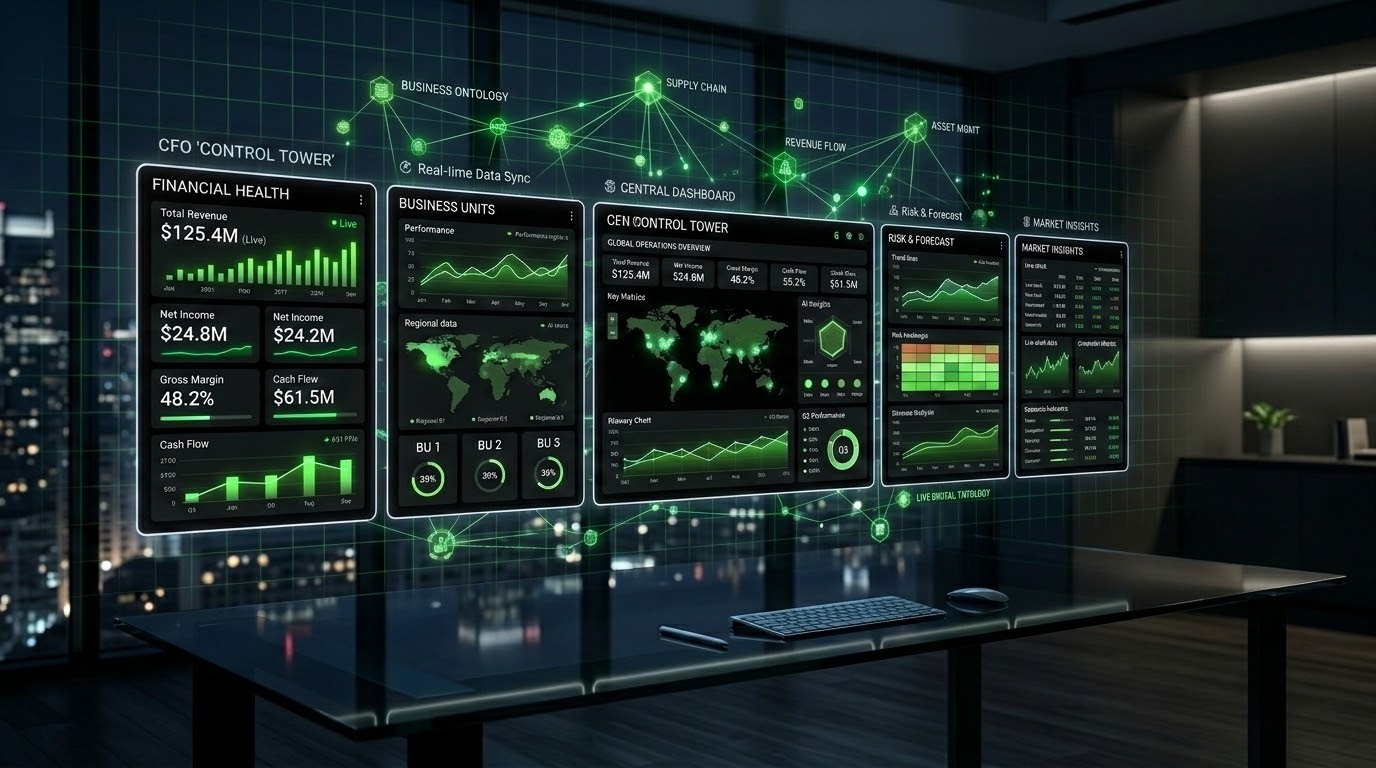
Plug Truzer into NetSuite, Sage Intacct, SAP, Workday, Dynamics, QuickBooks, or Xero. Actuals flow in. Forecasts flow back. No flat-file uploads, no middleware scripts, no read-only connector that breaks the moment your auditor asks for drill-down.
Lazer AI reasons over the ontology with a deterministic math layer, not a probabilistic language model. Every variance commentary cites the journal entry. Every forecast traces to the driver. The board sees the math, not the hallucination.
Stop renting consultants to maintain a 47-tab model. The ontology generates the rolling forecast, the variance commentary, the scenario branches, and the board package live from the ledger. Reforecast in minutes.
The ontology is the digital twin of your P&L. Every account, every entity, every driver, every budget version mapped in one semantic model. Update an assumption, the entire forecast recalculates. Lock the budget, the forecast still iterates against it.
Implementation
Administrator burden
Forecast architecture
AI in the boardroom
ERP integration
Deployment
Commitment
48 hours from now, your next reforecast is either a 47-tab spreadsheet rebuild or a live ontology query. Both have a price.
Every FP&A team we've worked with started in the same place. Here is how Truzer fixes the surround.
Your ERP, your subledgers, your operational systems, your existing budget files. Truzer reads from your stack via native connectors. No rip-and-replace, no flat-file exports, no Power Automate scripts.
The ontology builds the digital twin of your P&L live. Every account, every entity, every driver visualized as one navigable map you can drill from the consolidated number to the source transaction.
Click any node on the P&L. Truzer surfaces the underlying transactions, the variance drivers, the budget delta, and the rolling-forecast trend. Drill from the board number to the journal entry in seconds.
Lazer AI generates the forecast, drafts the variance commentary, and routes the action email to the right department head. Grounded in your ledger. Deterministic math. No hallucinations.
Truzer reads from the systems you already run. No data migration. No ERP swap. No middleware to maintain.
Plug Truzer into NetSuite, Sage Intacct, SAP, Workday, Dynamics 365, QuickBooks, or Xero. The ontology starts building the moment the connection is live. Bi-directional sync.
The gap between the locked annual budget and the rolling forecast is where every board conversation lives. Here is the operator's playbook for closing that gap with discipline rather than spreadsheets.
Accounting software records what already happened. FP&A software models what comes next. The accounting system owns the general ledger, the trial balance, and the close. FP&A software builds the budget, the rolling forecast, the variance commentary, and the scenarios that drive next-quarter decisions on top of that ledger. Both run in parallel, integrated bi-directionally so the forecast updates against actuals each month.
The best FP&A software for mid-market companies goes live in days, runs without a 0.5 FTE administrator, and connects bi-directionally to your ERP. Mid-market finance teams cannot afford a six-figure consulting implementation or a sandbox that demands a proprietary modeling language. Architecture beats brand recognition.
No. Truzer goes live in 48 hours on top of your existing ERP. You connect, the ontology starts building, and your team self-serves from there. No implementation partner. No six-figure professional services contract. No 0.5 FTE administrator. Month-to-month, cancel anytime. The platform is built for finance teams who refuse to rent consultants to operate their own software.
Lazer AI reasons over the live ontology with a deterministic math layer, not a probabilistic language model trying to predict the next likely number. Every variance commentary cites the journal entry behind it. Every forecast traces to the driver assumption. The board sees the math, not a hallucination. Surveys show 86% of CFOs have hit AI-generated fabrications in finance tasks. Truzer's reasoning layer is built so that does not happen.
Yes. Truzer connects bi-directionally to all seven via native APIs. Actuals flow into the ontology. Forecasts and scenario adjustments flow back to the ERP. No duct-tape Power Automate scripts, no flat-file uploads, no read-only connectors that break the moment your auditor asks for transaction-level drill-down. If you run multiple ERPs across entities, Truzer reads them all into one unified P&L ontology.
Book a call with Craig and Michael. Walk through your ERP, your entities, and your last forecast, and see your P&L running on the live ontology without a single consulting line item.