

Accounts receivable management is the end-to-end process a business uses to collect the money its customers owe, from setting credit terms through to applying the final payment. It turns credit sales into cash on time, without straining the customer relationship. The work starts the moment you extend payment terms and ends when the cash clears the bank and the ledger reconciles.
Accounts receivable management covers five linked stages:
- Credit approval. Deciding who gets terms, and what limit.
- Invoicing. Issuing an accurate invoice the customer’s AP system will accept.
- Collections. Following up on overdue balances on a structured cadence.
- Dispute resolution. Fixing the operational reason an invoice stalled.
- Cash application. Matching incoming payments to the right invoices.
When any one of those links breaks, cash stalls.
Table of Contents
Most of it breaks in one place
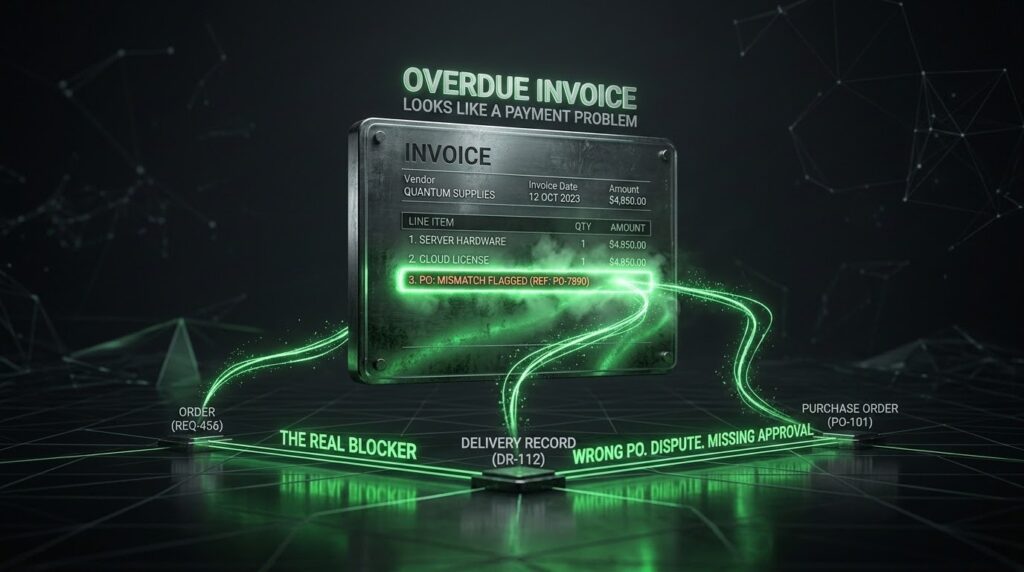
Your most profitable customer owes you $87,000 and the invoice is 61 days past due. The collections team sends another reminder. The customer ignores it. Not because they refuse to pay, but because the PO number on line three does not match their system and nobody on your side has noticed. That single mismatch stalls the entire payment, in the gap between “the money is late” and “the invoice has an error nobody owns.”
Most AR content walks you through the same playbook: invoice promptly, set clear terms, follow up, escalate, write off. That process is real and worth knowing. But the highest-leverage work in receivables is not chasing the symptom of a late payment. It is finding and fixing the operational reason the invoice stalled in the first place. This guide covers the full process, the metrics, and the uncomfortable truth that a large share of overdue invoices are not collection problems at all. AR management sits at the intersection of finance and operations, and most teams treat it as a finance task when the failures are operational.
Why profitable companies run cash-tight
A business can show strong revenue and healthy margins on the income statement while struggling to make payroll. The gap is timing. Revenue recognition and cash collection are separate events. If your average customer pays 20 or 30 days later than your terms allow, that gap compounds across hundreds of invoices.
This is not a fringe problem. In the Federal Reserve’s Small Business Credit Survey, 66% of employer firms reported facing financial challenges in the prior year, and only one in five healthy firms held enough cash reserves to survive a two-month revenue loss. Working capital gets trapped in receivables. The P&L says you earned it. The bank account says otherwise. AR management is the discipline that closes that gap.
The accounts receivable management process, step by step
The AR cycle is a chain. Each link depends on the one before it. A weak credit policy creates collection problems downstream. A sloppy invoice creates disputes that look like late payments. Here is the full sequence.
Step 1: Credit approval
Before you extend terms, know who you are extending them to. Run a credit check. Set a credit limit. Document the terms in writing. This step is the one most small and mid-market companies skip because the sales team wants the deal closed yesterday.
Skipping credit approval does not save time. It shifts the cost to collections 60 days later.
Step 2: Accurate invoicing
Invoice the same day the goods ship or the service delivers. Every invoice needs the correct PO number, the right billing contact, and the exact line items the customer expects. This sounds obvious. It is also where a large share of AR problems originate.
A wrong PO number, a mismatched price, or a missing approval code gives the customer’s AP team a legitimate reason to reject or hold the invoice. Your AR team then spends weeks chasing what looks like a slow-pay customer when the real cause is an internal data error.
Step 3: Payment terms and communication
Net 30 is the most common starting point. Net 15, Net 45, Net 60, and milestone-based terms all have valid uses depending on industry and deal size. The terms themselves matter less than whether both parties understand and agree to them before the first invoice goes out.
Put terms on the contract, on the invoice, and in the welcome communication. Ambiguity is the friend of late payment.
Step 4: Collections cadence
A structured follow-up schedule replaces ad hoc reminders. A common cadence looks like this:
- Day 1 past due. Automated reminder confirming the invoice is outstanding.
- Day 7. Direct email to the billing contact asking if there is an issue with the invoice.
- Day 14. Phone call or escalation to a senior contact on the customer side.
- Day 30. Formal notice with account hold or service suspension language, depending on your policy.
- Day 60+. Escalation to a collections agency or legal review.
The exact timing varies. The principle does not. Every touch should ask “Is there a reason this invoice is held?” before it asks “When will you pay?” A human reviews and approves every outbound message before it reaches the customer. Visibility surfaces the problem. A drafted reminder suggests the next step. But a person decides whether that message is the right one to send.
Step 5: Dispute resolution
Disputes are not exceptions. They are a normal, predictable part of any AR operation that handles volume. The question is whether you have a process for them or whether they sit in someone’s inbox.
A dispute resolution workflow needs an owner, a defined SLA, and a direct connection back to the order or delivery record that triggered it. If the customer says the shipment was short, someone needs to verify that claim against the proof of delivery within days, not weeks.
Step 6: Cash application and reconciliation
Cash comes in. Someone has to match it to the right invoice. When a customer pays a round number that does not match any single invoice, the AR team has to allocate it. When remittance data is missing or incomplete, the team guesses.
Manual cash application is one of the most time-intensive tasks in AR. It is also where errors compound silently, creating phantom balances that clog the aging report for months.
Step 7: Write-offs and bad debt
Some invoices will never be collected. A write-off policy defines when the business stops pursuing an invoice and recognizes the loss. The threshold is usually 90 or 120 days past due, after all resolution attempts are exhausted.
Write-offs should be small and predictable. If your bad-debt ratio is climbing, the problem is almost always upstream: credit policy or invoice accuracy. Not the write-off step itself.
Who owns what in AR
In a mature organization, AR management is distributed across several roles. In a founder-led business, one person wears most of these hats.
- CFO or controller. Sets policy, monitors KPIs, owns escalation decisions.
- AR manager or specialist. Runs the daily cadence, manages disputes, applies cash.
- Credit analyst. Evaluates new customers, sets and adjusts credit limits.
- Sales and account management. Owns the customer relationship context that AR needs to resolve disputes without damaging the account.
The biggest process failure in mid-market AR is not headcount. It is the handoff between sales and finance. Sales closes the deal with verbal promises about terms. Finance invoices based on the contract. The customer sees a gap and holds payment. Nobody owns the gap.
Core AR metrics that tell you something real
Metrics only matter if they lead to action. Three measurements form the backbone of AR performance. Track them together, never in isolation.
Days sales outstanding (DSO)
DSO measures the average number of days between invoicing and cash collection. The benchmark finance pros use: good DSO runs roughly 1.5x your terms. On Net 30, that means around 45 days. Enterprise reality runs 65 days or more.
DSO only makes sense inside the cash conversion cycle, which accounts for the time you hold inventory and the time your own payables buy you. Reading DSO alone is like reading one line of a three-line equation. Founders call it “the gap between payroll and payment.” That framing is honest.
DSO is also the most distrusted metric in AR. Teams delay invoicing to reset the clock. They “refresh” 90-day invoices by reissuing them as new. They write off bad debt early to remove aged balances from the calculation. They factor receivables to move the number off the books entirely. The reported DSO looks green. The cash stays trapped. This is not a tool problem. It is a category habit, and it reinforces the exact behavior AR management should prevent. For a deeper look at reducing this metric without gaming it, the sibling guide on how to reduce your DSO covers the full playbook.
Aging report buckets
The accounts receivable aging report sorts outstanding invoices by how long they have been unpaid: 0 to 30 days, 31 to 60, 61 to 90, and 90+. Each bucket tells a different story, and the actions for each are different.
This guide will not replicate the deep-dive on reading and acting on each bucket. That lives in the dedicated aging report article. What matters here is that the aging report is your primary triage tool. If you only look at one report each week, make it this one.
Bad-debt ratio
Bad-debt ratio measures write-offs as a percentage of total credit sales. A rising ratio signals upstream failures: loose credit policies or unresolved disputes that fester past the point of recovery. For scale, the Atradius Payment Practices Barometer found that bad debts average around 8% of all B2B credit sales in the US, with roughly half of all B2B invoices overdue.
Track it monthly. Compare it to the volume of disputes opened in the same period. The correlation is direct.

Where the process breaks
AR management has a public story and a private one. The public story is that customers pay late because they are slow or difficult. The private story, the one operators live with, is that most stalled invoices are caused by something the selling company did or failed to do.
Most payment problems are operational, not financial
Segment your overdue invoices by reason, not just by age or dollar amount. When you do, a pattern emerges. A large share of overdue balances trace back to one of these causes:
- Wrong or missing PO number on the invoice.
- Price on the invoice does not match the contract or quote.
- Goods received do not match the packing slip or order.
- The customer’s internal approver never received the invoice.
- A credit memo was promised but never issued.
- Delivery was disputed and no one followed up with proof.
None of these are collection problems. They are operational defects. Sending another payment reminder does nothing to resolve a mismatched PO. It just annoys the customer and wastes your team’s time.
The highest-leverage work in AR is fixing the reason an invoice stalls, not chasing the symptom. This is the spine of effective accounts receivable management. The invoice is the artifact. The root cause is the work.
How to segment overdue accounts by reason
Most AR teams sort overdue balances by age bucket or dollar value. Both are useful for triage. Neither tells you what to do next.
Add a third dimension: stall reason. Tag every overdue invoice with the specific blocker. Wrong PO. Missing approval. Delivery dispute. Pricing discrepancy. Unknown (customer not responding). Then run the aging report grouped by stall reason instead of by customer or amount.
The output changes how you allocate your team’s time. If 40 invoices are overdue and 25 of them have a known operational blocker, your priority is not to send 40 reminders. It is to fix 25 invoices so they can clear.
The relationship cost of tone-deaf escalation
Every collections action has a relationship cost. A polite reminder at seven days costs almost nothing. A legal threat at 45 days, sent before anyone checked whether the invoice was actually correct, can destroy a customer relationship that took years to build.
The worst version of this is automated escalation with no human judgment. The system flags an invoice as 30 days overdue and fires a stern template. The customer, who has been waiting three weeks for someone on your side to fix a billing error, receives the message and decides to take their business elsewhere.
Escalation cadence should match the stall reason, not just the age of the invoice. A disputed invoice at 45 days needs a resolution conversation, not a demand letter. A customer who historically pays on time but is seven days late on one invoice needs a gentle check-in, not a credit hold.
Build your escalation tiers around what you know about the invoice, not just how old it is.
How stronger AR extends cash runway
Cash runway is the number of days, or months, your business can operate on available cash. Receivables are the single largest variable in that equation for most B2B companies. Every day you shave off your average collection time adds directly to runway.
The math is blunt. If you bill $500,000 per month and your average collection time drops from 60 days to 45 days, you free roughly $250,000 in working capital. That is not new revenue. It is cash you already earned, arriving sooner.
This is why AR management is not a back-office function. It is a cash runway decision. The CFO or founder who treats receivables as an accounting task instead of an operational priority is leaving cash trapped in a process nobody watches closely enough. Collecting it sooner feeds straight into your Live Cash Runway.
Connecting AR to operational truth
Running AR against operational truth, the live state of orders, deliveries, and approvals, is what separates reactive collections from proactive receivables management. Truzer connects the systems receivables live in, including ERP, billing, and order and delivery records, and surfaces why a specific invoice is stuck so finance can fix the cause instead of sending another reminder. It drafts the right next step and queues it for a human to approve. The ontology is the live digital twin of the business. Same thing.
The point is not the tool. The point is the principle. If your AR team cannot see the order, the delivery confirmation, and the contract terms from the same screen where they see the overdue invoice, they are guessing. And guessing is expensive.
Practices that hold under pressure
Best practices lists tend to be aspirational. These are the ones that survive contact with real customers and real volume.
Invoice on the same day you deliver. Every day you wait to invoice is a day added to your effective DSO that no collection effort can recover.
Validate PO numbers before invoicing. One field check prevents weeks of back-and-forth. This is the single highest-ROI process improvement in most AR operations.
Run a weekly aging review with stall-reason tagging. Not monthly. Weekly. Disputes age fast. A 14-day-old dispute is a conversation. A 60-day-old dispute is a write-off risk.
Separate dispute resolution from collections. The person trying to resolve a billing error should not be the same person sending payment demands. The incentives conflict, and the customer feels it.
Align sales and finance on terms before the contract signs. Verbal side deals on payment terms are the leading cause of invoice disputes that neither team wants to own. Put it in the contract or do not promise it. For a broader look at the AR automation software that supports these practices, the sibling guide covers what to look for.
The invoice is the artifact. The cause is the work.
Accounts receivable management is not a collections function. It is an operational discipline that happens to end in cash. The companies that collect faster are not the ones with the most aggressive follow-up cadence. They are the ones who fix the reason invoices stall before the first reminder goes out.
Chase the symptom and you train your team to send reminders. Fix the cause and you train your organization to ship clean invoices and resolve disputes in days, protecting the customer relationships that make the revenue possible in the first place. That is the work. The cash follows.
Try Truzer or Book a call