

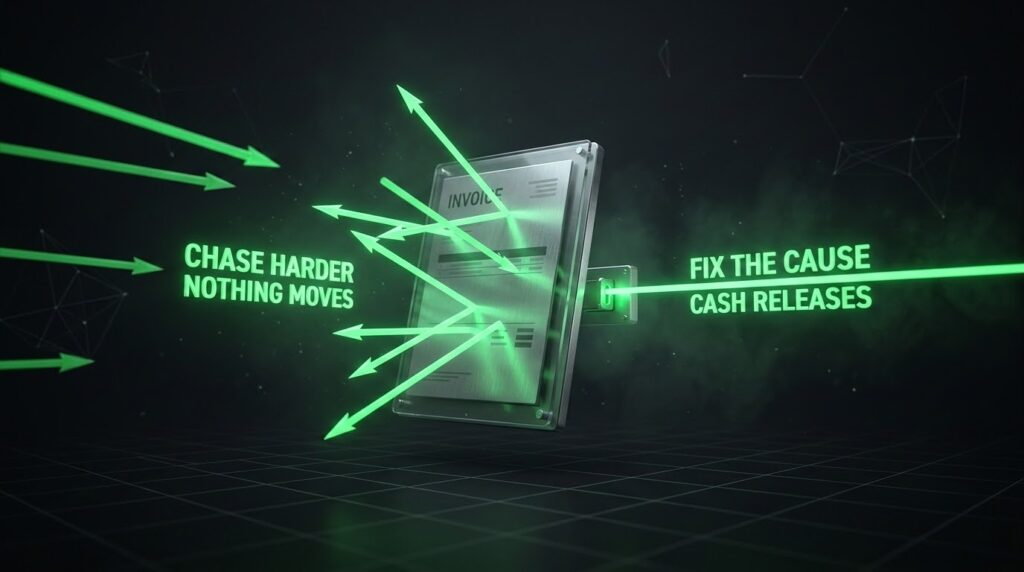
To reduce DSO (days sales outstanding) means to shorten the average number of days it takes your company to collect payment after a sale. A lower DSO converts revenue into spendable cash faster, which strengthens working capital and extends cash runway. The fastest way to do it is rarely to chase customers harder. It is to fix the operational reasons invoices stall before anyone sends a reminder.
In practice, reducing DSO comes down to a few moves working together:
- Invoice faster and cleaner. so the payment clock starts sooner and nothing bounces back.
- Set terms that match the account. and the risk, not a single blanket policy.
- Fix the operational blockers. (wrong PO, disputed line, missing approval) that freeze invoices.
- Follow up on a consistent cadence. instead of escalating at random.
- Track the right metrics. so you see why collection speed is changing, not just that it changed.
This guide covers each of those, then lands on the move most DSO advice skips: diagnosing why a specific invoice is stuck, and fixing the cause instead of escalating the symptom.
Table of Contents
Why most efforts to reduce DSO backfire
Your accounts receivable team sends a fourth reminder on a 45-day-old invoice, and the client fires back: “We told you last month the PO number was wrong.” That single exchange captures why most efforts to reduce DSO backfire. The chase gets faster, but the cash does not.
How DSO is measured
Finance teams track DSO monthly or quarterly to gauge collection efficiency and spot deterioration early. Read on its own it is a blunt number, so most teams watch the trend rather than the single figure, and read it against their payment terms and customer mix. A rising trend is the early signal that something in the order-to-cash process is slipping.
The DSO formula and a worked example
The standard formula is straightforward:
DSO = (Accounts Receivable / Total Credit Sales) x Number of Days
Suppose your AR balance at month-end is $600,000 and your credit sales for the 30-day period total $1,200,000. Your DSO is ($600,000 / $1,200,000) x 30 = 15 days.
That 15-day result tells you the average invoice converts to cash in about two weeks. If your standard terms are Net 30, a 15-day DSO signals strong collection performance. If your terms are Net 15, the same number reveals you are collecting right at the deadline with no cushion.
Some teams use average AR (beginning plus ending, divided by two) instead of the ending balance. The average-AR version smooths out spikes from a single large invoice landing on the last day of the period. Pick one method and use it consistently so your trend line stays honest.
What counts as a good DSO
There is no universal “good” number. DSO is meaningful only relative to your payment terms and your customer mix. As a general reference point, Investopedia notes a DSO under 45 days is considered good for most businesses, but that rule of thumb breaks down the moment your terms or industry differ.
A SaaS company billing Net 30 with a 35-day DSO has a modest gap. A construction firm on Net 60 with the same 35-day DSO is collecting well ahead of terms. Comparing the two numbers without context is meaningless.
As a working rule, DSO should sit at or below your weighted-average payment terms. When it creeps five or more days above terms, something in your order-to-cash process needs attention. When it drifts 15 or more days above, the cause is almost never “clients are slow.” It is process failure on your side, their side, or both.
Standard levers to reduce DSO
These tactics appear in every DSO article for good reason. They work. The risk is treating them as a checklist rather than a system. Each lever has a cost, a trade-off, and a context where it fits best.
Set clear and shorter payment terms
Moving from Net 60 to Net 30 compresses the timeline mechanically. But shorter terms only reduce DSO if your clients accept them and your invoices are accurate enough to avoid disputes. Tightening terms on a client who already pays on time is risk without reward. Start with new contracts and renewals rather than resetting every open account at once.
Invoice faster and more accurately
Every day between delivery and invoice creation is a free day added to DSO. If your billing team waits five business days after fulfillment to generate an invoice, you have already padded DSO by a week before the client even sees the bill. Automate invoice triggers tied to delivery confirmation or milestone completion. This is the cheapest lever you have.
Require deposits or progress payments
For project-based or high-value work, deposits and milestone billing shift cash collection earlier in the engagement. This shrinks the receivable balance at any point in time, which lowers DSO directly.
Offer multiple payment options
ACH, wire, credit card, and digital payment links each remove a different friction point. Some clients delay because the only option is a paper check routed through a centralized AP department. Adding a payment link to the invoice itself removes that bottleneck.
Early-payment incentives
A 2/10 Net 30 discount (2% off if paid within 10 days) trades margin for speed. The trade-off is steeper than it looks: a 2% discount to pull payment forward 20 days annualizes to roughly a 36% cost of capital. It works well for high-volume accounts where cash velocity matters more than the margin hit. It works poorly if your margins are thin. Run the math before offering it broadly.
Consistent follow-up cadence
A structured reminder sequence removes ambiguity. A typical cadence looks like this:
- Invoice sent on day 0 with a clear due date
- Friendly reminder 7 days before the due date
- Follow-up on the due date
- Escalation at 7 days past due
- Second escalation at 15 days past due with a direct phone call
The cadence matters less than its consistency. Irregular follow-up trains clients to deprioritize your invoices.
Credit checks on new accounts
Running a credit check before extending terms catches high-risk accounts before they become overdue receivables. This is not about refusing business. It is about setting the right terms for the right risk profile. A client with poor credit history gets prepayment or Net 15 terms, not Net 60. Before you tighten credit policy broadly, check your write-off history. If write-offs are low, credit is not your DSO problem.
The operational root causes most teams miss
Here is the part most DSO advice skips entirely. A large share of overdue invoices are not overdue because the client chose not to pay. They are overdue because something broke in the process, and the invoice is sitting in limbo.
The client’s AP team received an invoice with the wrong PO number and routed it to a dispute queue. Or the invoice references a line item the client never approved. Or it landed in a shared inbox that no one monitors. The payment is not late. The invoice is stuck.

Why chasing stuck invoices harder backfires
Sending a second and third reminder on an invoice the client already flagged as incorrect does not accelerate cash. It accelerates frustration. The client’s AP clerk sees your automated reminder, checks their system, confirms the invoice is in dispute, and ignores the email.
Your AR team sees the aging report, escalates to a collections call, and the client’s procurement lead now fields a collections inquiry on an invoice they already told you was wrong. You have not reduced DSO. You have damaged a relationship and burned internal labor on both sides.
Segment overdue accounts by reason, not just age
The standard accounts receivable aging report sorts invoices by how many days they are past due. That is useful for spotting magnitude. It is useless for diagnosing cause.
A 60-day-old invoice from a client with a wrong PO number needs a data correction. A 60-day-old invoice from a client with cash flow problems needs a payment plan conversation. Treating both identically is the fastest way to solve neither.
Build a root-cause segmentation layer on top of your aging report. At minimum, tag every overdue invoice with one of these categories:
- Data error. wrong PO, incorrect billing address, or mismatched line items
- Dispute. client contests pricing or deliverable quality
- Approval stall. invoice requires internal sign-off that has not happened
- Delivery issue. invoice sent to the wrong contact or inbox
- Willingness to pay. the client is choosing to delay payment
In most B2B environments, the first four categories account for a far larger share of overdue dollars than the fifth. Your accounts receivable management process should reflect that reality.
A root-cause-to-remedy map
Once you tag the reason, the fix becomes specific rather than generic.
| Root cause | Leading indicator | Remedy |
|---|---|---|
| Wrong PO number | High first-touch dispute rate | Validate PO at order entry before invoicing |
| Late invoice creation | Gap between delivery date and invoice date exceeds 3 days | Automate invoice trigger at delivery confirmation |
| Invoice sent to wrong contact | No open or click on invoice email | Confirm AP contact and email during onboarding |
| Disputed line item | Repeated disputes from same client or same SKU | Improve proof-of-delivery and order accuracy controls |
| Stalled internal approval | Invoices pending approval beyond 5 days | Shorten approval chain or set auto-escalation rules |
| Client cash flow issue | Consistent late payment across all invoices | Restructure terms, require deposits, or reduce credit limit |
This map converts your AR review from a blunt aging conversation into a diagnostic one. Each row points to a different owner and a different fix.
The relationship cost of escalating the wrong invoices
A loyal client who buys $2M a year and pays reliably does not deserve a collections call because your system sent an invoice with the wrong billing entity. That call does not accelerate payment. It signals that your company does not track its own process failures.
The damage is not abstract. Procurement teams keep score. A vendor that escalates incorrectly moves down the preferred-vendor list. Future RFPs get tighter scrutiny. Renewal conversations start with “we need to talk about your billing process” instead of “let’s expand the scope.”
Reducing DSO and protecting client relationships are not in tension. They are the same goal when you fix the cause instead of escalating the symptom. The controller who calls a client to resolve a wrong PO before the invoice ages past 15 days protects the relationship and collects faster than the one who sends an automated escalation at day 45.
KPIs to track beyond DSO
DSO alone does not tell you why collection speed is changing. Pair it with supporting metrics that point to specific process breakdowns.
- Collection Effectiveness Index (CEI). the percentage of receivables collected in a period. A falling CEI alongside stable DSO means new invoices are masking a growing overdue tail.
- Average Days Delinquent (ADD). the gap between DSO and your best possible DSO if every client paid on time. A rising ADD isolates the delinquency problem from the terms structure.
- Dispute rate. the share of invoices that enter a dispute workflow. A high dispute rate points directly to invoice accuracy or fulfillment problems.
- Invoice accuracy rate. the percentage of invoices sent without errors on the first attempt. This is the upstream metric that predicts dispute rate. Fix it, and the lagging indicators follow.
Track these monthly. Review them together, not in isolation. A DSO improvement driven by shorter terms but accompanied by a rising dispute rate is a warning, not a win.
How reducing DSO extends cash runway
Every day you shave off DSO frees cash that was trapped in receivables. The math is direct.
If your average daily credit sales are $100,000, each day of DSO reduction releases $100,000 in cash. Cut DSO by 10 days and $1,000,000 moves from receivables into your bank account. That is not revenue growth. It is cash you already earned, arriving sooner.
For a company burning $500,000 per month in operating expenses, $1,000,000 in freed cash adds two months of cash runway. That extension does not require a fundraise, a credit line, or a cost cut. It requires fixing the process that was holding cash hostage.
This connection between DSO and runway is where finance leaders find the most compelling business case for operational fixes. Delayed customer payments are one of the most common cash-flow pressures small and mid-sized firms report, a pattern documented year after year in the Federal Reserve’s Small Business Credit Survey. A wrong PO number that delays payment by 20 days on a $200,000 invoice is not an administrative inconvenience. It is $200,000 in cash you cannot deploy for three extra weeks. Multiply that across dozens of invoices and the runway impact becomes material.
Tighter cash flow forecasting becomes more reliable as DSO drops, because the variance between expected and actual collection dates narrows. Forecasts built on a 45-day DSO with high variance are guesses. Forecasts built on a 30-day DSO with low variance are plans.
Making root-cause visibility operational
The root-cause approach works only if you can see the cause in real time. That is where most finance teams hit a wall. The AR aging report lives in the ERP. The dispute notes live in email. The PO validation data lives in the procurement system. The approval status lives in a workflow tool. No single view connects them.
Manual reconciliation across those systems is what turns a fixable 5-day issue into a 45-day overdue invoice. By the time someone cross-references the data, the aging report has already escalated the reminder sequence, and the relationship damage is done.
This is the operational problem a live ontology solves. Truzer connects the systems receivables live in (ERP, AP/AR, billing) and surfaces why a specific invoice is stuck: the wrong PO, the open dispute, the stalled approval. The ontology is the digital twin of how your business actually operates. Finance sees the cause before the aging report triggers an escalation, so the fix goes to the right person on the right day instead of a blanket reminder going to a client who already told you the invoice was wrong.
The technology matters less than the principle. Your AR process needs a single view that connects invoice status, dispute reason, and approval state across every system involved. Without that, root-cause segmentation stays a manual exercise that breaks down at scale.
The bottom line
The fastest path to reduce DSO is not a louder reminder sequence. It is an accurate invoice with the right PO, sent to the right person, on the day the deliverable ships. Everything downstream of that first step becomes easier when the invoice arrives clean.
Start with your aging report. Tag every overdue invoice by root cause, not just by age. You will find that a large share of your overdue dollars trace back to fixable process errors, not unwilling clients. Fix those errors at the source, and DSO drops without a single uncomfortable collections call.
The cash was always coming. You just need to stop blocking it.