Mortgage AI is the use of machine learning, natural language processing, and computer vision to perform cognitive work inside the loan lifecycle, including reading documents, validating income, flagging risk, and routing exceptions. It differs from older automation because it interprets unstructured, inconsistent inputs and improves from feedback, where rule-based automation only follows fixed steps. Across origination in 2026, AI assists at each stage while a human still owns every credit decision, a line drawn by lending regulation rather than preference.
Mortgage AI does its work in five distinct functions across the loan:
- Document classification and extraction reads W-2s, paystubs, bank statements, and tax returns from messy, real-world inputs.
- Income, asset, and credit validation cross-checks extracted data against the 1003 and third-party sources.
- Underwriting support pre-screens a file against agency rules and surfaces risk, while the underwriter decides.
- Condition management and clear-to-close matches incoming documents to open conditions and flags the gaps.
- Post-close QC and compliance monitoring checks the closed file against TRID, HMDA, and QM requirements.
Table of Contents
That definition is clean. The production reality is not.
Every lending executive has watched the demo. The model reads a paystub, classifies the document, and fills the 1003 in seconds. The room nods.
Then the pilot meets a real borrower. A self-employed applicant sends a K-1 with income split across two LLCs, a bank statement missing its middle page, and a verification of employment written by hand. The model stalls. The file drops into an exception queue that costs more to clear than keying it from scratch would have.
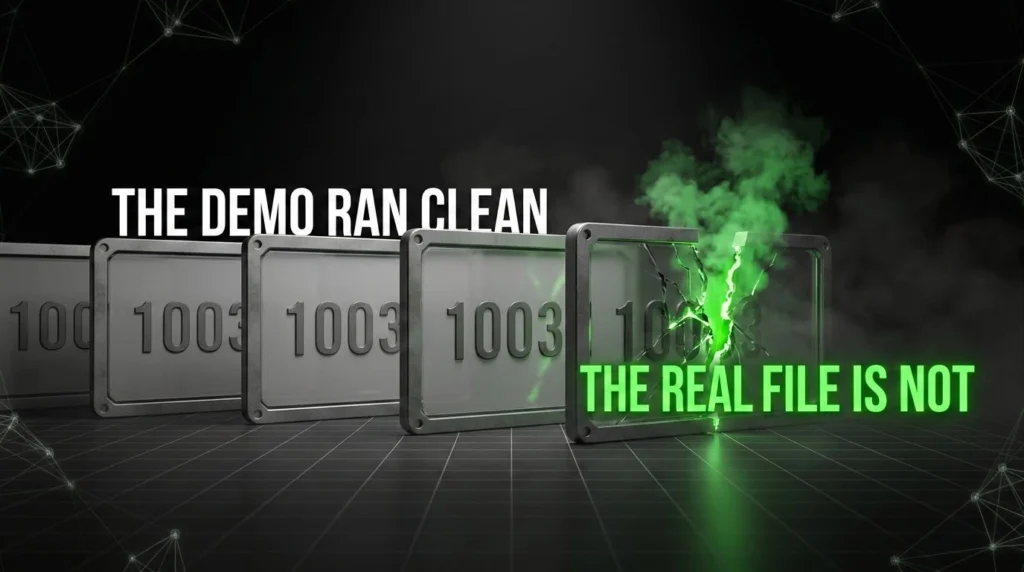
That distance between the demo and the floor is where mortgage AI is actually decided. The demo ran clean because the demo ran on a clean file, and clean files are the exception in this business, not the rule.
This guide is about the floor. What AI does and does not do across the loan, where it earns its place and where it adds work, what the 2026 rules now require, and how to measure whether any of it paid off. The intent is an operator’s reference, written for the people who run the pipeline rather than the people who sell to it.
The reality problem
Start with the thing the vendors get wrong.
The mortgage industry does not have a data problem. It has a reality problem. The data exists, in volume, across the loan origination system, the point-of-sale portal, the borrower’s inbox, and a dozen verification services. What is missing is one live, validated picture of what is actually true about a file right now.
Legacy tools report on the pipeline after the fact. A human keys the income, a second human checks it, a third chases the missing page, and by the time a dashboard shows the loan, the number on the screen is a description of work already done and already, in places, wrong. The dirty file is not really a document problem. It is what an application looks like when no system holds the truth of it in one place.
That gap is why the doc chase never ends and why a borrower can upload the same statement three times. The portal says received. The conditions list says missing. Both are looking at the same document and neither can see the other. A loan officer on an industry forum put the daily version of this plainly: most of the day goes to manual entry and chasing borrowers for files they already sent.
Fix the reality and the rest follows. Fail to fix it, and every AI tool bolted on top inherits the same blindness, faster.
What mortgage AI is, and what it is not
The label gets stuck on everything. A macro that auto-fills a field is sold as AI. A chatbot with a decision tree is sold as AI. Before an executive spends a budget, three things need to be told apart.
Workflow automation follows rules a person wrote. If a file hits day three, fire the disclosure package. It does not learn, and it breaks the moment the input changes shape.
Robotic process automation copies keystrokes between screens. It moves a value from the portal to the loan origination system and stops being useful the instant a field moves or a form version updates.
Mortgage AI is the part that reads a blurry phone photo of a bank statement, recognizes it as page two of three, and flags the missing first page. It works on unstructured input and gets better with correction. That is the dividing line. If a tool cannot handle a messy document or improve from feedback, it is automation wearing the word AI.
One more distinction matters in 2026, because it is where the real gains and the real risk both live. Generative AI writes: a borrower email, a summary of conditions, a first-draft reply to an underwriter. Agentic AI acts. It takes a goal, breaks it into steps, runs them across systems, and brings back a result for a person to approve. The honest mental model is a tireless junior processor that checks the index against the conditions list, finds the three missing items, drafts the borrower request, and stages the file for a person to sign off.
The dirty file is the median file
Vendor demos run on clean PDFs. Production runs on dirty files, and every processor knows it before the contract is signed.
The pattern repeats on every operations floor. A borrower uploads a blurry photo of a paystub. A bank statement arrives without its middle page. A self-employed applicant sends business and personal funds co-mingled in one account. A verification of employment shows up handwritten and sideways in a portal that cannot rotate it. This is not the edge case the pilot was tested against. This is the typical file.
The borrower black hole
A document uploaded to the borrower portal often fails to index against the underwriter’s conditions. The borrower sees a green checkmark. The processor sees an unmatched attachment. The system fires a second request for a file the borrower already sent, and the borrower reads it as incompetence while the lender’s own marketing promised advanced AI.
That mismatch costs more trust than a slow closing does. Operators consistently report that fixing the document-to-condition mapping buys more borrower goodwill than shaving a day off cycle time, because the borrower forgives a wait but not the feeling of shouting into a void.
Where income AI quietly underdelivers
Income extraction is the highest-value problem in mortgage AI and the one most oversold. Tools handle a salaried W-2 borrower with a digital paystub well. The accuracy falls the moment variable income appears: commissions, seasonal bonuses, K-1 distributions, rental income spread across multiple schedules. Handwritten verifications of employment are worse, because handwritten dates and employer shorthand defeat the reader on a routine basis.
The result is the trap. The model produces a number, the number is wrong, and clearing the exception costs more time than the calculation would have taken by hand. The tool meant to save the processor time can end up costing it. None of this means income AI is useless. It means the production-ready use case is narrower than the slide deck, and an operator who scopes for the narrow version wins while the one who believes the deck does not.
Where AI fits across the loan
AI touches every stage of origination, but the maturity is uneven, and treating it as uniform is how budgets get wasted. Here is the honest read, stage by stage.
Intake and lead qualification. AI chat and voice systems qualify inbound leads, screen for basic eligibility, and route a borrower to the right loan officer. This is mature, and the risk is low, because no credit decision is being made when a system maps “I want to refinance my condo” to a product.
Document classification and extraction. This is the most active zone and the one the dirty file already explained. Classification of common types and field-level extraction on clean, structured documents both perform well. Accuracy drops on handwriting, low-resolution images, and multi-entity tax returns, which is the clean-majority, hard-minority pattern the operator floor lives with every day.
Income, asset, and credit validation. AI cross-references extracted data against the application and third-party sources. When the data is digital and structured, this is fast. When the income needs real calculation, the model flags the file for a human, and that flag is the actual value, because catching a complex file before it reaches the underwriter saves a full round trip.
Underwriting support, not underwriting. Automated underwriting systems from the agencies, Fannie Mae’s Desktop Underwriter and Freddie Mac’s Loan Product Advisor, have run rule-based decisioning for years. AI sits in front of them: pre-screening a file against agency requirements, predicting likely conditions, staging documentation. According to Freddie Mac’s 2025 cost-to-originate study, lenders optimizing Loan Product Advisor can save about $1,700 per loan and shorten timelines by about five days. The underwriter still owns the decision, because no agency buys, insures, or securitizes a loan decided by a model that cannot explain itself.
Conditions and clear-to-close. This is where agentic AI shows the most near-term promise. The agent reads the conditions list, maps each item to documents already in the file, finds the gaps, drafts the borrower request, and tracks responses. ICE Mortgage Technology data put the average time to close a purchase loan at about 42 days in 2025, and much of that time goes to clearing conditions rather than to the credit decision itself. The metric that matters is the condition cure rate, the share of conditions cleared on the first try, because a higher rate means fewer round trips and fewer confused borrowers getting asked twice.
Post-close QC and compliance monitoring. Post-close review checks the closed file against TRID tolerances, HMDA accuracy, and QM safe-harbor. This is a strong fit, because the task is comparison against a fixed rule, and comparison on structured final data is exactly what these systems do best. The compliance officer still signs the attestation, because one mapping error between a field and a regulation can force a repurchase.
The pattern across all six stages is the same. AI is strongest where the input is clean and the question is comparison. It is weakest where the input is messy and the judgment is human. Scope to the first and the second stays where it belongs.
What is real and what is hype
Naming the hype is the fastest way to protect a budget.
The fully autonomous loan officer is not real. Borrowers want a human on the largest financial decision of their lives, and the ones forced through an all-chatbot origination drop out. The black-box underwriter fails for a harder reason: the agencies and secondary-market investors will not buy, insure, or securitize a loan whose decision a model cannot explain, and regulators require a specific, individualized reason for every denial. A vendor selling a fully automated mortgage is describing a demo that has never survived agency delivery, a state audit, and a borrower complaint at the same time.
What is real is quieter. The return on AI in lending comes from ending the stare-and-compare review: instead of one person keying a paystub and a second person checking it, the system extracts and a person validates. The work moves from data entry to exception handling, and the people move to relationships, complex structuring, and the judgment calls that were always the actual job.
The financial pressure behind this is concrete. The Mortgage Bankers Association put the average cost to produce a loan at about $11,090 in 2025, and the majority of that sits in fulfillment, the processing, underwriting, and closing work where human touches pile up.
AI earns its place by cutting touches on the clean majority of files so human attention concentrates on the hard minority. Adoption has already moved past pilots: STRATMOR Group’s Technology Insight Study found that 38 percent of mortgage lenders reported using AI and machine learning in 2024, up from 15 percent in 2023, mostly on document classification and validation. The genuinely hard problems, complex income and full automation, remain early. An operator who knows which is which buys the first and waits on the second.
The 2026 compliance reality
Regulatory specificity is what separates a credible AI program from a liability, and 2026 is specific enough to name.
The agencies have drawn the line directly. Fannie Mae Lender Letter LL-2026-04, which takes effect in August 2026, establishes a governance framework for AI and machine learning in origination and servicing, and its sharpest clause requires that the standards a lender applies to a third-party software vendor be no less protective than the lender’s own controls. If you hold your internal models to bias testing and explainability, you must hold every vendor to the same bar.
The CFPB position is blunt: there is no advanced-technology exception to consumer financial protection law. Adverse-action notices under the Equal Credit Opportunity Act and Regulation B must give a specific, individualized reason for a denial. A model that cannot say why it declined a borrower in terms that borrower can understand cannot be the thing that declines them.
The industry has answered with a shared playbook. MISMO released FRAME, the Framework for Responsible AI in the Mortgage Ecosystem, in June 2026, giving lenders governance templates and vendor checklists mapped to mortgage operations. It is the closest thing the industry has to a common standard, and an operator who adopts it early spends less time inventing one under audit pressure.
The state picture adds weight rather than clarity. Colorado’s automated-decision law and the Texas Responsible AI Governance Act both impose disclosure and governance duties that diverge from the federal baseline, so a national lender now manages a patchwork rather than a single rule. Underneath all of it sits the Gramm-Leach-Bliley Act, which bars routing borrower nonpublic personal information through unvetted public language models. Operators draw the same line on the floor: they will use AI kept inside the lender’s own perimeter and treat sending a Social Security number or a tax return through a public model as a liability they refuse to own.
This is why the human-in-the-loop model is the consensus operating posture in 2026 rather than a talking point. AI assists and a human decides, because the Equal Credit Opportunity Act, the Fair Credit Reporting Act, and the agency frameworks each require it. An operator who treats human oversight as a regulatory requirement scopes the system correctly. One who treats it as an optional cost scopes it wrong and finds out during an exam.
Where the validation layer fits
Everything above points to one missing piece. The tools work where the data is clean and break where the data is messy, and the data is messy because no system holds one validated picture of the file. That is the reality problem from the start of this guide, and it is the piece a digital twin is built to solve.
A real digital twin is a live, complete model of the business: every borrower, document, condition, and rule, connected in real time. Truzer’s name for that model is the ontology, and the serious operators in this category already think this way, because a model of the pipeline that updates as the pipeline moves is the only thing that can tell you why a file is stuck rather than just that it is. The ontology validates an application at intake, before a human keys anything, and surfaces the reason a loan is blocked: a missing appraisal, a failed debt-to-income check, an unverified large deposit.
This sits alongside the loan origination system, not on top of its grave. The system of record keeps doing its job. The ontology gives the operator the one thing the stack never had, a single source of truth for the live state of every file, so the AI bolted to it is grounded in reality instead of inheriting the blindness. A human still approves any borrower-facing step, which is both the regulation and the point. Humans decide. Automation executes.
How to deploy, and how to measure it
A program dies fastest when it is scoped as a rip-and-replace. The stack is interconnected, and pulling out a layer breaks the layers around it. The deployment that works starts narrow and grows outward.
Start the pilot on high-volume, standardized loans: conventional purchases from salaried W-2 borrowers. These files carry the cleanest data and the most predictable document set, which is exactly where extraction and classification already perform. Measure accuracy against the manual baseline, and expand only after the model beats the human on that slice. Save the hard files, complex income and non-standard products, for last, because a model still learning your data should not learn it on your worst cases.
Then integrate rather than isolate. An AI layer that cannot write back into the loan origination system creates a second manual step instead of removing one. The extracted income has to land in the application fields automatically, or the work was only moved, not saved.
Measurement is where credibility is won or lost in the board room. The metrics that matter tie to cost and cycle time:
- Touches per file. Every human handoff from application to closing. The number should fall.
- Submission-to-clear-to-close cycle time. Measure the baseline before deployment and again after, and trust the delta.
- Condition cure rate. The share of conditions cleared on the first borrower attempt. Higher means fewer round trips.
- Pull-through rate. The share of applications that reach closing. This is a revenue number, not an efficiency one.
- Cost per loan. The bottom line. Track it on the same product mix before and after, so the AI is what changed and not the market.
One warning. The share of files an AI touched is a vanity metric. A system that processes a high volume of documents while quietly reworking a large share of them is not winning, however busy it looks. Measure outcomes, and measure them on live files, including the dirty ones the demo never showed you.
Close, CTA, FAQs
The gap between the demo and the floor does not close by buying more software. It closes by putting AI on the narrow, high-volume work where the data is clean, grounding it in one validated picture of the pipeline, measuring it on real files, and keeping a human on every credit decision the law assigns to a human. The dirty file is not going away. The lenders who win are the ones whose systems handle the clean majority, flag the hard minority, and free their people for the work that always needed a human brain.
Mortgage AI is not a product to buy. It is an operating discipline to build, and it starts with the truth of the file. That is the premise behind automated mortgage application processing and pipeline intelligence: one validated picture of the file, grounded in the ontology, with a human on every decision the law assigns to a human.
Try Truzer to see your pipeline as one live picture. Or book a call to walk through it with us.
Compare the tools