Loan origination software (LOS) is the system of record that carries a mortgage file from application through closing. It stores borrower data, generates disclosures, tracks conditions, runs the automated underwriting submission, and produces the compliance documentation regulators expect. Every lender runs one, but no lender should confuse having a system of record with having control of the pipeline around it.
A loan origination system typically handles five core jobs:
- Application and data capture. Intake of the borrower’s 1003 and supporting data into one file.
- Disclosure and compliance. Automated TRID timing, HMDA fields, and an audit trail of every borrower-facing action.
- Condition and document tracking. Managing what is outstanding on a file before it can close.
- Automated underwriting submission. Feeding the file to Fannie Mae’s Desktop Underwriter or Freddie Mac’s Loan Product Advisor.
- Investor delivery. Packaging the closed loan for sale on the secondary market.
The list below ranks the loan origination software mortgage lenders and brokers actually run in 2026, what each does well, and the one gap none of them close on their own.
Table of Contents
Start on the floor, because that gap is where the real cost lives. Half an ops team burns a morning chasing a pay stub a borrower uploaded to a portal two weeks ago. The LOS recorded the file open. The processor never saw it. The underwriter flagged the gap at hour eleven of a rate lock. That sequence repeats across every channel, every day, at shops running five loan officers or fifty.
The real cost is not the rework. It is the fallout: a blown TRID deadline, a rate-lock extension fee, a compliance finding that traces back to data someone re-keyed wrong at intake.
Why the system of record is not the same as control
The LOS handles the file. It does not handle the chaos around the file. Borrower documents arrive through email, portals, fax, and text. Processors re-key data from one screen to another. Conditions sit in spreadsheets. Status lives in someone’s head.
That gap between the system of record and the intake layer is where files stall, data rots, and compliance risk compounds. According to the STRATMOR Group’s Technology Insight Study, 38% of lenders reported using AI or ML in 2024, up from 15% in 2023. The jump signals that operators know static workflows are not enough. The question is where to point that AI.
LOS vs. mortgage intake software
A LOS is a system of record. It stores the loan file, enforces disclosure timelines, and feeds investor delivery. Mortgage intake software sits upstream. It captures borrower data across channels, validates documents at the point of entry, and routes exceptions before a processor touches the file.
Most shops treat the LOS as both. That is where the “I spend half my life chasing docs” problem starts. The LOS was never designed to unify five intake channels into one clean data object. Expecting it to do so creates the re-keying, the dirty files, and the eleventh-hour surprises that burn out operations teams.
Key features the best loan origination software should include
Feature lists on vendor websites run long. Not all of them matter equally to a COO or VP of Operations choosing a system for a production floor. The features below separate working software from brochure software.
Workflow automation and rules engines
A rules engine should fire conditions based on loan product and investor overlay without manual configuration per file. If your team builds a new task template for every product change, the engine is a spreadsheet with a user interface.
Look for configurable triggers that route exceptions to the right person, not a queue. The difference between “assigned to a pool” and “assigned to the person who can fix it” is three days of cycle time.
Compliance controls and audit trails
TRID timelines, HMDA data fields, KYC and AML checks, fair lending documentation, and document retention policies are non-negotiable. The LOS should enforce disclosure timing automatically. Every borrower-facing action should produce an immutable, timestamped record.
Audit-trail paranoia is rational. Examiners do not accept “we think the processor sent that on Tuesday.” They accept a traceable log tied to the action and the timestamp. Any system that makes you reconstruct that log after the fact is a liability.
Credit pulls, fraud checks, and verification
Direct integrations with credit bureaus and verification vendors (income, employment, assets) cut days from the file. Manual ordering and re-keying of verification results is the single largest source of garbage-in data in most shops.
Best loan origination software for mortgage lenders in 2026
The systems below represent the tools mortgage lenders and brokers actually run in production. Each serves a different slice of the market. The ranking reflects operational fit, not marketing budgets.
Every system on this list does one job well, and none of them do the one that actually breaks your pipeline.
They all store the file. They all run the disclosures. What none of them do on their own is tell you why a specific file is stuck, right now, before the rate lock expires. The block is almost never the loan. It is a missing appraisal, a failed DTI check, an unverified deposit, a document a borrower uploaded that never indexed against the conditions. The system of record records the file. It does not hold the live, validated truth of the operation around the file.
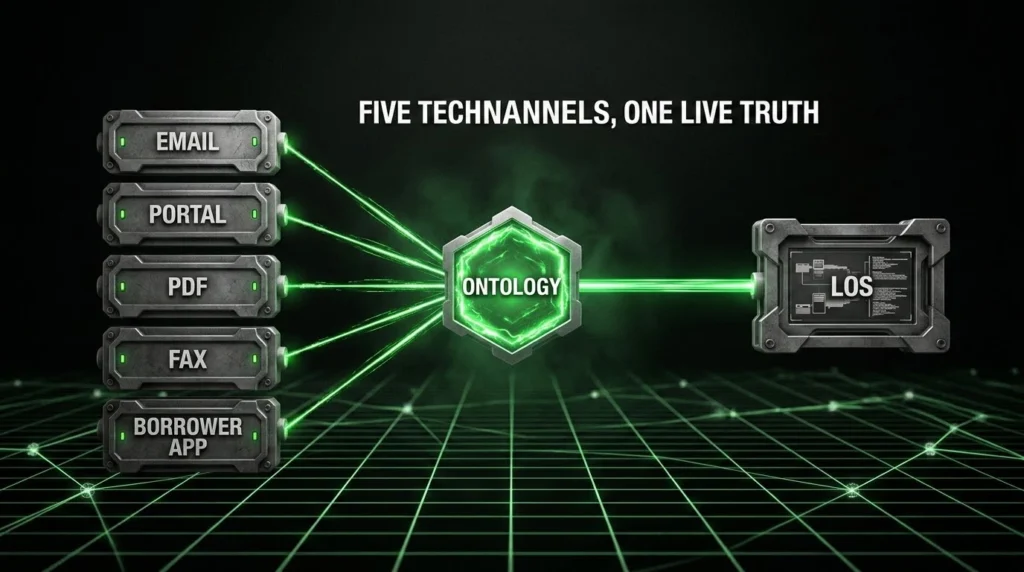
That truth is what a real digital twin holds, and Truzer’s name for it is the ontology. It sits alongside your LOS, unifies every intake channel into one live model, and surfaces the reason a file is blocked while a human still approves anything that reaches a borrower. The list keeps going below. Read it knowing that “best” depends on which gap you are actually trying to close.
1. Truzer: the AI integrator for mortgage operations
Best for: lenders who already have a LOS and need to unify fragmented intake into one live operational truth.
Truzer.ai is not another LOS. It is the AI Integrator that sits alongside your LOS and connects every intake channel (email, portal, PDF upload, borrower app) into one unified digital twin called the ontology. Same object. One live map of every file, every condition, every exception. Your LOS stores the file. Truzer is the control tower that knows why a file is stuck, whether the block is a missing appraisal, a failed DTI check, or an unverified deposit, and routes the fix to the right operator with human-in-the-loop approval on every borrower-facing action.
It validates data at the top of the funnel, not at underwriting, which kills the dirty-file problem at intake. Deployed in 48 hours, no rip-and-replace, with AES-256 encryption at rest and TLS 1.3 in transit.
2. ICE Mortgage Technology (Encompass)
Best for: mid-to-large lenders who want an all-in-one LOS with deep investor and vendor integrations.
Encompass is the market’s most widely adopted LOS. Its compliance engine and disclosure automation set the standard most shops measure against, and it handles the system-of-record job well. Where teams add layers of spreadsheets and workarounds is upstream: multi-channel intake, condition tracking across systems, and exception routing.
3. nCino mortgage suite
Best for: banks and credit unions already on Salesforce who want origination tightly coupled to their CRM layer.
nCino brings mortgage origination onto the Salesforce infrastructure, which gives institutions a single borrower record from CRM through closing. The trade-off is deployment complexity. Institutions not already invested in Salesforce face a longer rollout and a steeper change-management curve.
4. Blend
Best for: lenders prioritizing the borrower-facing digital application experience.
Blend’s strength is the consumer-facing point of sale. The borrower application flow is clean and fast, so lenders focused on pull-through rate and borrower satisfaction from application to initial submission will find it competitive. The back-office origination workflow depends on integrations with the LOS of record.
5. MeridianLink mortgage
Best for: credit unions and community banks running multiple lending products beyond mortgage.
MeridianLink serves institutions that originate consumer and mortgage loans on one infrastructure, and the multi-product flexibility is the draw. Mortgage-only shops with complex overlays will want to pressure-test workflow configurability during evaluation.
6. Calyx Software
Best for: independent mortgage brokers and small-to-mid lenders who need a proven LOS at a lower price point.
Calyx has served the broker channel for decades. Point and Path cover origination for shops that do not need the enterprise feature set of Encompass or nCino, with the value proposition being reliable origination at a manageable cost. Larger operations with complex condition management and multi-channel intake needs will outgrow it.
7. Mortgage Cadence
Best for: banks and credit unions that want an enterprise platform covering origination and the broader lending lifecycle.
Mortgage Cadence offers a configurable enterprise LOS with deep workflow and document capabilities, often chosen by institutions that want a single vendor across the lending stack. The configurability is the strength and the consideration at once, because a highly configurable platform rewards a shop with the internal resources to maintain it and asks more of one that does not.
8. Byte Software
Best for: independent mortgage bankers and brokers who want a flexible, established LOS with strong compliance tooling.
Byte has a long track record in the independent-lender channel and is valued for its flexibility and built-in compliance controls. Shops that want to tailor the workflow closely tend to favor it, while teams looking for a more opinionated, out-of-the-box flow will weigh that flexibility against setup effort.
9. LendingPad
Best for: brokers and smaller lenders who want a modern, cloud-native LOS with an open integration layer.
LendingPad is a cloud-based LOS known for a modern interface and an open API approach that makes it easier to connect third-party services. Brokers moving off legacy desktop systems often shortlist it for the user experience, and larger shops will pressure-test how its configurability scales to complex investor overlays.
How to evaluate mortgage origination software for your shop
Vendor demos show best-case scenarios. Your evaluation should test worst-case ones. Count your intake channels (email, portal, fax, text, PDF, borrower app), then ask each vendor whether the system unifies these into one data object or whether your processor re-keys from each channel. If the answer is re-keying, you are buying a faster spreadsheet.
Ask where validation happens. If the system validates data at underwriting, you discover the dirty file too late, after it has already consumed processor hours. Validate at intake instead, so the system surfaces what is wrong and who needs to fix it before the file moves downstream.
Test the exception routing. Pull a real stuck file from your pipeline, one with a missing appraisal, a failed DTI, and an unverified deposit, and walk the vendor through it. Ask how the system tells your team the file is stuck, why it is stuck, and who fixes each block. KPMG’s 2026 mortgage modernization advisory maps how lenders migrate from legacy LOS stacks to modular, AI-enabled origination architectures without business disruption, and the consistent theme is that structured intake and decision automation beat wholesale replacement.
The file is not the problem. The regime around it is.
Every system in this guide does something well. Encompass stores the file, nCino connects to Salesforce, Blend converts borrowers, Calyx serves brokers, MeridianLink covers multi-product lenders. None of them were built to unify five intake channels into one live data object, validate at the top of the funnel, and surface why a file is stuck before the rate lock expires.
That is the gap. The villain is not your LOS. It is the static-dashboard, spreadsheet, re-keying regime layered on top of it. One ontology. One operational truth. Zero dashboard silos.
Related mortgage guides