NAID AAA certification is the data-destruction industry’s audit-backed standard, administered by i-SIGMA. It verifies a company destroys data-bearing media securely through independent audits. This often occurs unannounced. It confirms that a certified operator meets strict requirements for employee screening and facility security.
NAID AAA certification verifies an operator across these areas:
The chain of custody and destruction method are also key aspects.
- Employee vetting. Criminal background checks, employment-history verification, and drug screening for anyone who touches data-bearing material.
- Facility security. Controlled access, monitored alarms, and a minimum 90-day archive of CCTV footage.
- Secure transport and chain of custody. Locked vehicles and an unbroken, documented trail from pickup to destruction.
- Destruction method. Physical or logical destruction that meets or exceeds NIST SP 800-88.
- Proof of destruction. A serialized Certificate of Destruction that ties each asset to the event that destroyed it.
Table of Contents
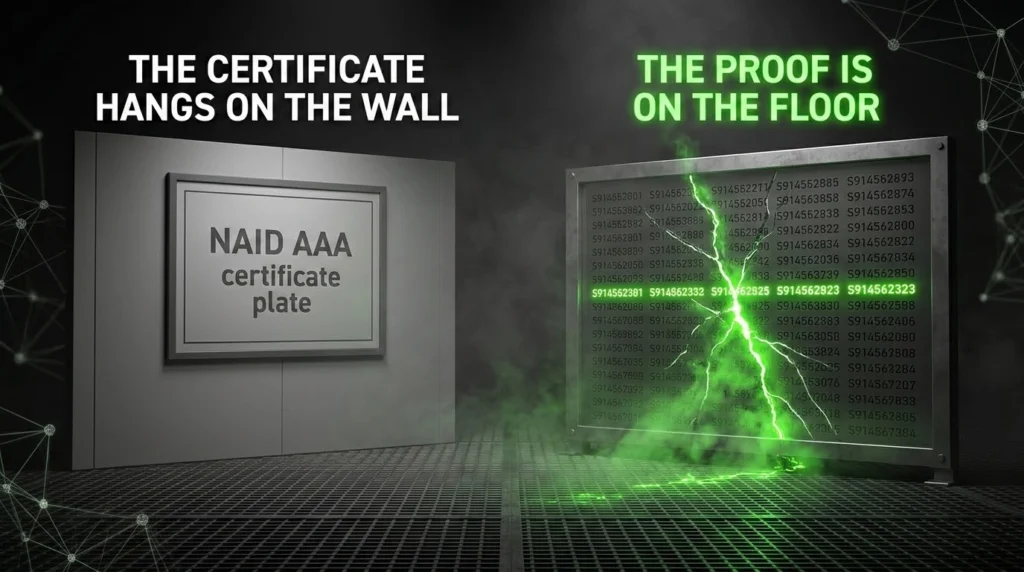
The certificate is the easy part. It hangs on the wall the day you pass.
The hard part arrives on an ordinary Tuesday, with no warning, when an independent auditor walks onto your floor, pulls a chain-of-custody file at random, and points at a pallet. Every serial number on that manifest has to match what is physically in front of you, right now. One drive you cannot account for is not a paperwork gap. It is a missing data-bearing device, treated as lost until you prove otherwise, and it can unwind months of clean operation.
That gap between holding the certificate and proving it under a surprise audit is crucial. This guide covers what the standard requires and how the audits actually work.
The certificate versus the proof
Start with what the badge does not tell you.
A NAID AAA certificate confirms an operator was capable of meeting the standard on the day it was audited. However, it does not, by itself, prove that the specific pallet of drives a client sent last week was tracked, matched, and destroyed without a single serial falling through. Those are two different claims. The distance between them is the entire job.
The proof lives in reconciliation. A client decommissions four hundred laptops and exports the expected serial numbers from their own system. The operator scans every asset at intake. Every serial on the client list has to appear on the intake scan, and every scanned asset has to trace forward to a destruction record. When the two lists disagree, and they routinely disagree, the operator has to explain why. A barcode peeled off in transit. A motherboard swapped in a repair three years ago that nobody logged. An asset tag moved to a different machine. Each discrepancy is a small mystery, and an auditor does not grade mysteries on effort.
This is why a polished certificate, on its own, has stopped convincing the people who read them. A clean PDF with a logo and a count of destroyed drives is indistinguishable from a fabricated one if nothing underneath ties each serial to a verifiable, time-stamped record. The serious buyers know this now. They no longer ask whether you are certified. They ask whether you can prove it.
Hold the certificate and you are in the game. Prove it on demand and you keep the contract.
What NAID AAA is, and who governs it
NAID AAA is a voluntary certification for companies that destroy data-bearing media, covering both physical destruction, the shredding of drives, paper, and tape, and logical destruction, the software-based wiping of devices. It validates that a facility meets the standard for vetting, access, chain of custody, and method. Scope is granular: a company certified for paper shredding is not automatically certified for hard-drive destruction, and a buyer has to read the certificate for the media types that actually appear on it.
The program is governed by i-SIGMA, the International Secure Information Governance and Management Association, formed in 2018 when NAID, the original National Association for Information Destruction, merged with PRISM International. The naming still trips people up, so it is worth stating plainly. i-SIGMA is the organization.
NAID AAA is the certification program it runs. A vendor who says “i-SIGMA certified” and a vendor who says “NAID AAA certified” are pointing at the same audit-backed standard. PRISM Privacy+ is a separate i-SIGMA program for records-management companies, focused on storage rather than destruction, so it is not the credential to ask for when the concern is secure destruction. Crucially, i-SIGMA administers the standard and runs the audits. It does not destroy anything itself.
How NAID AAA differs from R2v3, e-Stewards, and ISO 27001
Buyers conflate these constantly, and treating them as interchangeable leaves a real gap in a compliance program. Each one governs a different slice of the asset’s afterlife.
| Certification | Governing body | Primary focus | Audit model |
|---|---|---|---|
| NAID AAA | i-SIGMA | Data-destruction security, access control, chain of custody | Scheduled plus unannounced surprise audits |
| R2v3 | SERI | Responsible recycling, circular economy, downstream e-waste tracking | Scheduled audits; includes data-sanitization requirements (Appendix B) |
| e-Stewards | Basel Action Network | Ethical recycling, no toxic exports | Scheduled audits; requires processors to also hold NAID AAA for data security |
| ISO 27001 | ISO/IEC | Information-security management system (a policy framework) | Scheduled audits; no physical destruction verification |
The distinction that matters: R2v3 and e-Stewards govern where the material goes after processing. NAID AAA governs how the data is destroyed and whether you can prove it. ISO 27001 governs your security policies on paper but sends no one to measure a shredder’s output. e-Stewards concedes the point directly, requiring its certified processors to also hold NAID AAA for data-bearing media. That is why an enterprise request for proposal so often lists “NAID AAA and R2v3” together. One covers the destruction. The other covers the downstream.
What the certification actually requires
The requirements are not merely policy language. They dictate how a certified operator hires, builds, transports, destroys, and documents each action.
Employee vetting. Every employee with access to unprocessed data-bearing material passes background screening, which includes criminal-history checks, employment-history verification, and drug screening. This covers drivers, floor staff, and anyone who handles a chain-of-custody record. The quiet burden is upkeep. Turnover in warehouse roles means screening never stops, and an auditor who pulls a file and finds an expired check has found a finding.
Facility security and CCTV. A certified facility controls access to every area where unprocessed media is stored or destroyed, with badge access, visitor logs, and monitored alarms. Surveillance covers access points and the processing floor, and the footage has to be retained for a minimum of ninety days. That ninety-day archive is a defined NAID requirement, not a suggestion, and an auditor can ask to see a specific date inside that window and expect it on demand.
Secure transport and chain of custody. Assets travel in locked, secured vehicles, and the chain-of-custody record opens at pickup: who loaded the assets, which containers and seals were used, when the vehicle reached the facility. This is where the serialized manifest enters, and it is the same manifest that decides a surprise audit. Every asset the client listed has to appear on the intake scan, and every scanned asset has to trace forward to a destruction record.
Destruction method. NAID AAA requires destruction that meets or exceeds NIST SP 800-88, the federal guideline that defines three tiers, Clear, Purge, and Destroy. NAID does not publish one universal particle size as a public headline rule; it requires the method and the result to meet the standard for the media and the data’s sensitivity. In practice, certified operators destroy to specific, demanding thresholds. High-security destruction is commonly cut to six millimeters or smaller, and to roughly two millimeters for top-secret-grade media, sizes aligned with NSA and CSS expectations rather than invented in-house. Solid-state media forces the issue, because degaussing does nothing to flash memory and software wiping is unreliable across wear-leveling and over-provisioning, so physical destruction becomes the dependable route.
The Certificate of Destruction. The certificate is only as strong as the data behind it. A defensible one carries the serialized asset identifier, the method and standard used, the date and time, and the responsible technician. A summary line, “five hundred drives destroyed on June 12,” is not defensible, because an enterprise client and its regulators expect a per-asset record tying each serial to a specific destruction event. The certificate is the last link in the chain of custody, not a standalone document you generate at the end.
How a company earns and keeps it
Certification follows a defined sequence, and there is no shortcut through it.
It starts with membership. NAID AAA is a benefit of i-SIGMA membership, so a company joins first and pays membership dues separately from the certification fees. The certification fees themselves run from $1,248 to $5,802 per year, scaling with the scope of operations: the number of locations, mobile versus plant-based service, physical destruction versus electronic erasure. Once a complete application and the supporting documentation are in, the process to the initial audit typically takes four to eight weeks, depending on how ready the operation actually is.
The audits are run by independent professionals, each holding the Certified Protection Professional accreditation from ASIS International, because i-SIGMA does not audit its own members. That independence is deliberate, and it is the answer to the pay-to-play suspicion some buyers carry about industry certifications.
The program then combines scheduled audits with unannounced ones. The unannounced audit is what gives the credential its weight. An auditor can arrive on any business day and ask for background-check files, the ninety-day CCTV archive, a particle-size measurement of the shred output, and chain-of-custody records matched to the assets sitting on the floor. This is why certified operators describe living in a state of permanent readiness rather than preparing for a known date.
Findings run on a spectrum. Minor ones require a corrective action inside a defined window. Serious or repeated failures go to i-SIGMA’s Member Resolution Council and can end in fines or the revocation and public removal of the certification. Renewal is annual, and the surprise-audit cycle never closes, which means certification is not a thing you achieve. It is a state you stay in.
Why it matters: the liability
The regulations do not name NAID AAA, but they create the exposure that makes it valuable. HIPAA, the Gramm-Leach-Bliley Act, the FACTA Disposal Rule, and GDPR each require organizations to dispose of sensitive data securely and to demonstrate that it happened. A certified operator with serialized proof is how a disposing company shows it exercised that diligence.
The cost of failing this is documented, and it is large.
Morgan Stanley used a moving and storage company with no data-destruction experience, rather than a certified ITAD provider, to decommission its data centers. It never reconciled the asset inventories. Devices holding unencrypted data on roughly fifteen million customers were resold, and during a later hardware refresh the firm found that forty-two servers with sensitive customer data were missing. The SEC penalty was thirty-five million dollars in 2022, and the broader fallout across regulators and class actions ran well past that.
Healthcare carries the same exposure at a different scale. The HHS Office for Civil Rights fined Parkview Health System eight hundred thousand dollars after employees left seventy-one boxes of medical records unattended on a retiring physician’s driveway, within feet of a public road.
The standards aim to protect both the operator and the enterprise. A certified operator with serialized proof is essential for demonstrating compliance with regulations.
The operator’s real pain
Earning the certification is one problem. Surviving daily life under it is another, and operators on industry forums name the same three pressures the standard itself does not solve.
The first is reconciliation, and it is the single largest source of audit failure. The client exports its expected serials, the operator scans intake, and the two lists disagree as a matter of routine. A barcode peels off in transit, a motherboard swapped in some old repair carries a serial that no longer matches its chassis, or an asset tag gets moved to a different machine in a shuffle the client never recorded. Each gap has to be chased down, because an asset on the client’s list that never appears in the intake scan is treated as lost or stolen until proven otherwise, and reconciling thousands of serials across two independent lists by hand is where clean operations go to break.
The second is the spreadsheet itself. Operators describe scanning barcodes into Excel ahead of a shred event, comparing their list against the client’s afterward, and matching it line by line. One forum contributor called it spreadsheet hell, and the phrase travels because the available tooling tends to cover one part of the workflow and leave the seams to manual cross-referencing. Each handoff between a scanning system, a destruction log, and a final certificate is a place where a serial can drop or transpose.
The third is the defensibility the whole thing rests on. A polished PDF with a logo and a count is, as one compliance professional put it, the moment you stop evaluating the wipe and start evaluating whether you trust the evidence. The hard question is not whether the shredder ran. It is whether you can prove the logs are the same ones that existed at the time. Distrust runs deep enough in this market, fed by insider-theft stories and the pay-to-play suspicion, that enterprise buyers no longer take the certificate on faith. They want per-asset serials, logs tied to those serials, and the ability to pull a record and check it.
Where the tracking layer fits
Everything above points at one missing piece. The certification sets the bar, but the daily failure is in the proof: the reconciliation, the seams between systems, the certificate that cannot defend itself. That is a tracking problem, and it is the problem a digital twin is built to solve.
A real digital twin is a live, complete model of an operation, every asset, every handoff, every state, connected in real time. Truzer’s name for that model is the ontology, and the serious operators in this category already think this way, because a model that updates as the pallet moves through the floor is the only thing that can hold the chain of custody as one unbroken record rather than a reconstruction stitched together after the audit knocks. For a NAID AAA certified operator, the ontology is the system of transparency and asset tracking that matches the certification requirements exactly: every serial logged at intake, every state change time-stamped, every destruction event tied to the device it destroyed, immutable and ready to produce on demand.
This is worth stating without ambiguity, because the category is full of vague claims. Truzer does not destroy data, and Truzer does not issue the certification. The certified operator runs the shredder and holds the credential. What the ontology provides is the proof layer underneath it, the serialized, time-stamped, single source of truth that turns a polished PDF into a record an auditor cannot poke a hole in. The operator destroys and certifies. The ontology proves.
How to vet a certified vendor
A certificate confirms a vendor passed its last audit. It says nothing about how that vendor handles your specific assets on a specific day. These are the questions that separate an operator who holds the standard from one who lives it.
- Can you give me per-asset serial numbers on the Certificate of Destruction? A summary certificate is not defensible. Ask to see a sample showing individual serials tied to destruction records.
- How do you reconcile your intake scan against my asset manifest? The answer reveals the real process. If it is Excel and manual line-matching, you now know the risk you are buying.
- What happens when a serial on my manifest has no match in your scan? A strong vendor has a documented discrepancy process, with escalation steps and a client-notification timeline.
- How long do you retain CCTV footage, and can you pull a specific date on demand? The NAID AAA minimum is ninety days. Ask whether they exceed it and how fast they can produce it.
- Are your destruction logs time-stamped and immutable? Logs that can be edited after the fact undermine the whole chain of custody. Ask how they prevent it.
- When was your last unannounced audit, and what were the findings? A confident operator answers directly, and evasion is the signal.
- Do you hold NAID AAA for every media type I need destroyed? Certification is scoped by media. Confirm the certificate covers drives, SSDs, tape, and paper for everything in your inventory.
Close
NAID AAA sets the highest bar in data-destruction security. The unannounced audits, the CPP-accredited auditors, and the prescriptive requirements for vetting, facility security, and chain of custody build a framework that no other standard matches for destruction specifically. However, the certificate is the floor, not the finish. The operators who thrive under it are the ones who solve the daily grind: reconciling serialized manifests without a gap, closing the seams between scanning and destruction logs, and producing certificates that still hold up years after the shred event. The buyers who gain the most from it are those who look past the badge and ask for the evidence behind it. The final check is that NAID AAA certification is essential for effective data management.
Try Truzer for a live, provable record of your chain of custody. Or book a call to discuss it with us.
Related Content