IT asset disposition ITAD software is the system an operator uses to run every stage of an IT asset’s end-of-life: intake, serialized tracking, data destruction, grading, remarketing, recycling, and compliance reporting. Most ITAD operations outgrow spreadsheets long before anyone admits it. Serial numbers get rekeyed. Custody gaps open between pickup and destruction. Audit season becomes a hunt for certificates nobody can find.
The right ITAD software ends that hunt. It replaces fragmented spreadsheets with one system of record that tracks every asset from dock receipt to final disposition. Before choosing one, you need to know its core functions and where the real differences between platforms sit.
Core functions to expect from any serious ITAD software:
- Asset intake and inventory with barcode or RFID scanning at the dock
- Serialized tracking of every device through each custody event
- Data destruction integration with NIST 800-88 erasure or physical shredding verification
- Resale and remarketing workflows with grading and pricing
- Downstream vendor management for R2- or e-Stewards-certified processors
- Compliance reporting and certificates of destruction tied to individual serial numbers
That is the baseline. The difference between platforms shows up in the messy parts: custody hand-offs between facilities, and audit trails that satisfy enterprise clients. Reporting that holds up under NAID AAA scrutiny is what separates a real platform from a dressed-up spreadsheet.
Table of Contents
Why IT asset disposition fails without chain of custody
An ITAD operation can erase every drive perfectly and still fail an audit. The failure is not in the destruction. It is in the gap between pickup and proof.
Chain of custody is the serialized record proving that a specific device moved through every stage: received at the dock, logged by serial, stored in secure hold, erased or shredded, and dispositioned. Each transition carries a timestamp, an operator ID, and a location. Break one link and the certificate of destruction loses its credibility.
Where custody gaps appear
The most common gap sits between client pickup and facility intake. A pallet arrives with 200 laptops and the manifest says 200, but nobody scans serials at the door. Three weeks later a client asks for proof that serial number X was destroyed, and the spreadsheet has nothing tied to that specific device.
The second gap sits between the systems themselves. The erasure tool logs a wipe, the ERP holds the asset record, and the two have to be reconciled by hand before a certificate ships. Every manual reconciliation is a place the chain can break.
What NAID AAA actually requires
NAID AAA certification demands a documented chain of custody from receipt to destruction. Every asset, every serial, every hand-off. The certification body audits for gaps, not just outcomes, so an operator who destroys every drive but cannot prove the chain from intake to shredder does not pass.
This is why software selection matters beyond inventory management. The system has to produce an unbroken, serialized, time-stamped record. Not a summary. Not a batch count. A per-device audit trail.
How ITAD ERP software runs assets from intake to disposition
A dedicated ITAD ERP replaces the patchwork of spreadsheets, emails, and disconnected logs with one workflow engine. The asset enters at the dock, and every subsequent event writes to the same record.
The intake-to-disposition workflow
At intake, the operator scans each device by serial or barcode, and the system creates an asset record with client association, lot number, and receiving timestamp. The asset then moves through testing, where functional status and cosmetic grade are recorded.
Data destruction comes next. The ERP either runs its own erasure module or connects to a tool like Blancco, and the result writes back to the asset record with a pass or fail flag and the method used. Failed drives route to physical destruction queues automatically.
After erasure, graded assets move into remarketing, and the ERP tracks listing, sale, and revenue per device. Assets that cannot be resold route to recycling with downstream vendor assignment and weight-based tracking. Every path ends in a reportable outcome tied to the original serial.
ITAD software vs general ERP vs ITAM tools
General ERP systems like NetSuite or SAP handle procurement and forward logistics well, but they are not built for reverse logistics or destruction verification. IT asset management (ITAM) tools like ServiceNow or Ivanti track assets during their useful life and stop at retirement.
ITAD software picks up where ITAM ends. It is the execution layer for end-of-life: the reverse logistics, the destruction, the remarketing, and the compliance trail. Running ITAD workflows inside a general ERP recreates the rekeying and custody gaps that spreadsheets produce.
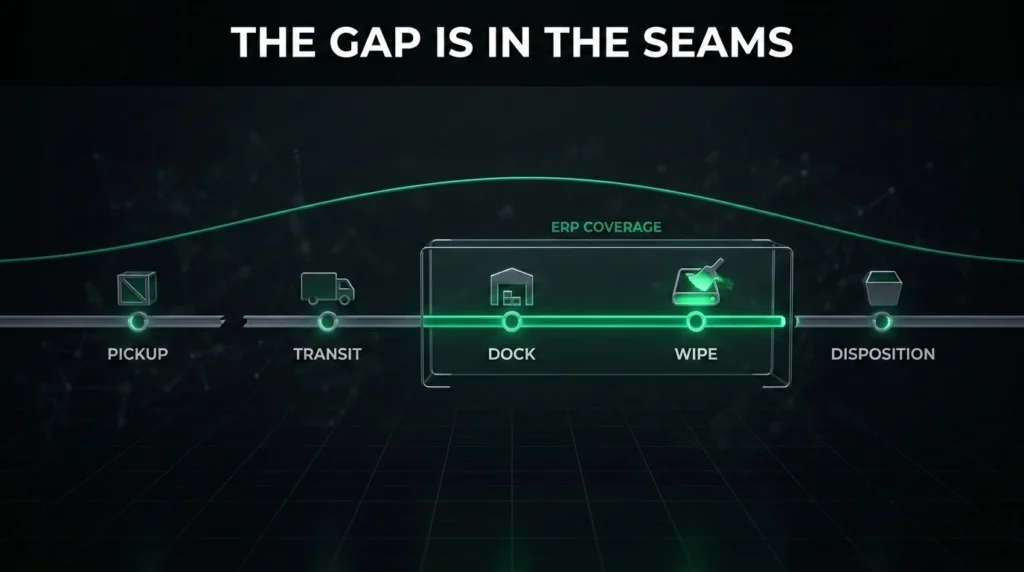
Here is the limit every platform below shares. An ITAD ERP is a system of record for what happens *inside your facility*. It logs the intake scan, the wipe result, the grade, the sale. What it does not own is the chain *before and around* those events: the pickup at the client site, the transit custody, the receiving discrepancy, the drive that left one system and entered another.
A NAID AAA auditor lives in those seams. Truzer is built for them. Truzer is not an ITAD ERP and not a data eraser. It is the chain-of-custody and proof layer, built on a live ontology that is the digital twin of your operation, that ties the whole journey to one serial and makes it immutable, sitting alongside the ERP you already run.
Best ITAD software for operators and asset managers
These platforms are ranked on honest merit and best-for fit. Each serves a different operational profile, and none does everything perfectly.
1. Recycly
Recycly is purpose-built as an ITAD ERP, covering intake, testing, grading, erasure integration, and remarketing in one system for ITAD operators and e-waste recyclers. The serialized tracking runs deep, and reporting spans both compliance certificates and revenue recovery.
Best for: Mid-size ITAD operators who need a dedicated reverse-logistics ERP and want to stop stitching spreadsheets to general-purpose tools.
2. RazorERP
RazorERP targets IT asset remarketers and refurbishers. Its strength is inventory management with detailed grading, lot tracking, and multi-channel sales synchronization. The remarketing workflow is tight, and compliance reporting sits secondary to the resale engine.
Best for: ITAD companies whose primary revenue comes from remarketing and refurbishment rather than destruction services.
3. Makor ERP
Makor ERP is built for IT asset recovery and recycling, handling intake, testing, data erasure, and parts harvesting from prospecting and pickup through production into resale and downstream. The reporting connects disposition outcomes to individual assets, and the interface mirrors an actual facility floor. The learning curve is steeper, and the depth matches a full-service operation.
Best for: Full-service ITAD and electronics recycling operations that handle high volumes and need parts-level tracking alongside device-level disposition.
4. Asset Panda
Asset Panda is a flexible asset-tracking tool, not a dedicated ITAD ERP. Its strength is configurability: custom fields, workflows, and check-in/check-out for almost any asset type. It lacks native erasure integration and downstream recycling tracking.
Best for: Enterprise IT asset managers who need to track assets across the full lifecycle and want a configurable bridge between ITAM and basic disposition tracking. Less suited to high-volume operators running a facility.
5. BlueTally
BlueTally is a lightweight asset-management tool built for simplicity. Setup takes minutes, the interface is clean, and it handles check-in/check-out and basic lifecycle tracking well. It does not offer ITAD-specific features like erasure verification or destruction certificates.
Best for: Small IT teams that need a simple asset register and are not running a dedicated ITAD operation.
6. Iron Mountain (ITAD services with software)
Iron Mountain offers ITAD as a managed service with its own tracking portal, giving enterprise clients chain-of-custody reports, certificates of destruction, and ESG reporting. You buy the service, and the portal comes with it. The trade-off is vendor lock-in, because your data lives in their system and switching providers can mean losing access to historical records.
Best for: Enterprises that want one vendor to run ITAD logistics and destruction without building internal operations.
Which ITAD platform for which operator profile
| Operator profile | Platform | Why |
|---|---|---|
| Mid-size ITAD, full reverse-logistics ERP | Recycly | Dedicated ITAD ERP, deep serialized tracking, compliance + revenue reporting |
| Remarketing- and refurb-led revenue | RazorERP | Inventory and grading depth, multi-channel sales sync |
| Full-service, high-volume, parts harvesting | Makor ERP | Cradle-to-grave depth, parts-level plus device-level tracking |
| Enterprise ITAM bridging into disposition | Asset Panda | Highly configurable lifecycle tracking, not facility-grade ITAD |
| Small IT team, simple asset register | BlueTally | Fast, clean, basic lifecycle tracking |
| Enterprise wanting a managed service | Iron Mountain | Outsourced logistics + destruction with a client portal |
| Any of the above needing audit-grade proof | Truzer (proof layer, not an ERP) | Ties the full pickup-to-destruction chain to one serial, immutable |
The layer above the list: Truzer
The platforms above run the ITAD workflow. Truzer provides the proof that the workflow happened exactly as documented.
Truzer is not an ITAD ERP. It does not run erasure, grade devices, or manage remarketing. It is the chain-of-custody and transparency layer that sits alongside the operator’s ERP and erasure tools.
What Truzer does:
- Logs every serial number at intake with timestamp and location
- Records every state change as the asset moves through the lifecycle
- Ties every destruction event to the specific device serial
- Produces an immutable, auditable record that matches NAID AAA chain-of-custody requirements
No one edits the record after the fact, and no one reconciles two systems by hand before an audit. The proof exists as a continuous, serialized, time-stamped chain from the moment the asset enters custody to the moment it is destroyed, resold, or recycled. That chain lives in the ontology, the unified digital twin of your operation.
Truzer does not replace your ERP and does not replace your erasure tool. It is the layer that makes both of them audit-proof. Deployed in 48 hours. No rip-and-replace.
How to choose the right ITAD software for your operation
Start with your operational profile, not a feature checklist. A facility running 10,000 devices a month needs a different platform than an enterprise IT team retiring 500 laptops a quarter.
Workflow fit comes first. Map your actual process from dock to disposition. Does the platform match it, or force you to change how you work? Tools that make you adapt your floor to their UI create friction that compounds at scale.
Custody integrity is the second filter. Can the system produce a per-device, serialized audit trail from intake to final outcome? If it only tracks batches or lots without serial-level granularity, audits get painful.
Reporting depth separates basic from serious. Enterprise clients expect certificates tied to individual serials, and your sustainability team expects ESG and recycling reports with downstream vendor accountability. The system needs both without manual assembly.
Erasure integration matters if you destroy data in-house. The ERP should connect to your erasure tool and write results back automatically, because manual log imports create the reconciliation gaps that cause audit failures.
Be wary of platforms that need long implementation timelines. ITAD operations move fast, and a system that takes six months to deploy costs more in spreadsheet risk than it saves in features.
The system you choose is the proof you produce
ITAD software is not a back-office convenience. It is the system that produces the evidence your clients, auditors, and regulators rely on. Every serial, every hand-off, every destruction event, documented or it did not happen.
Pick the ERP that fits your workflow. Pick the erasure tool that meets NIST 800-88. Then run the proof layer that ties the full chain to one serial and makes both of them audit-ready.
Try Truzer to add the chain-of-custody layer your operation needs. Or book a call to see how the proof layer works alongside your existing systems.
Related ITAD guides