What is Medical Courier Software?
Medical courier software is specialized logistics software for the transport of specimens, pharmaceuticals, and cryogenic cargo. Compliance-grade operations run under continuous chain of custody, real-time environmental monitoring, and regulatory compliance validation. Most tools in this category stop at dispatch and routing. Five capabilities separate a compliance-grade operation from a contract termination:
- Immutable Chain of Custody: Hashed, tamper-evident records at every handoff point from pickup to final delivery.
- Real-Time Environmental Monitoring: Continuous temperature and condition telemetry tied to the shipment, not just the vehicle.
- Automated Regulatory Compliance: Credential verification, route lockout, and audit-ready documentation generated without manual input.
- Unified Stakeholder Communication: A single encrypted channel for dispatchers, drivers, clinics, and patients.
- Route-Level Profitability: Real-time margin calculation per route factoring fuel, dwell time, compliance costs, and dispatcher labor.
If you run a 5-to-50-vehicle medical courier operation, these five requirements matter. They separate a tool that survives an audit from one that causes a contract termination.
Table of Contents
Where Current Medical Courier Tools Fail
Most tools in this market were designed for last-mile consumer delivery and retrofitted for medical use. The retrofit breaks under pressure in five specific areas.
Chain of Custody Is a Photo, Not a Ledger
Most tools call a delivery photo chain of custody. It is not. Medical specimens require timestamped, tamper-evident records at every handoff between courier, facility staff, and lab intake. A photo does not hold up under FDA audit. It proves arrival. It does not prove who held the specimen at 2:47 PM or whether custody was transferred to a credentialed recipient.
GPS Tracks the Truck, Not the Cargo
Vehicle coordinates tell you where the truck is. They tell you nothing about whether the cargo is exceeding its temperature corridor. Operators need environmental telemetry tied to the shipment itself. A specimen can degrade inside a properly located vehicle if the dewar seal fails or the cold pack expires.
Compliance Is Manual and Fragile
Driver certifications, HIPAA training records, BBP/HazCom dates, DOT hours of service. All in spreadsheets. One lapsed certification on a sensitive route is grounds for contract termination. Manual tracking guarantees this happens eventually.
Communication Lives in WhatsApp
Dispatchers call drivers every 20 minutes for status updates. Clinics have no ETA visibility. Patients tracking embryo shipments are in the dark. Data flows through unsecured consumer messaging apps. Every text containing patient information is a HIPAA violation waiting to surface in discovery.
Profitability Is a Guess
No real-time margin per route. Fuel costs, dwell time, dispatcher labor, and compliance overhead get reconciled in spreadsheets after the billing cycle closes. By then, you have already run unprofitable routes for weeks.
Chain of Custody: The Requirement That Defines the Category
Chain-of-custody complexity is the silent killer in medical courier operations. No other requirement separates compliance-grade specimen tracking software from a basic dispatch tool as clearly as this one.
Frozen embryo transport is the highest-stakes example. A single embryo stored at -196°C in a liquid nitrogen dewar represents years of fertility treatment and unquantifiable personal value. A single custodial breach during transit triggers multi-party litigation involving the clinic, the courier, and the storage facility.
The legal exposure is real and documented. More than 300 embryo-related lawsuits were filed between 2019 and 2024 according to NBC News. A PMC published study tracked the frequency and claims basis over a 10-year period. The largest verdict reached $15 million in the Pacific Fertility Center case in 2018. The average settlement sits at $199,188. Typical transit insurance covers $5,000. That gap between $199,188 and $5,000 is what compliance-grade chain of custody software exists to close.
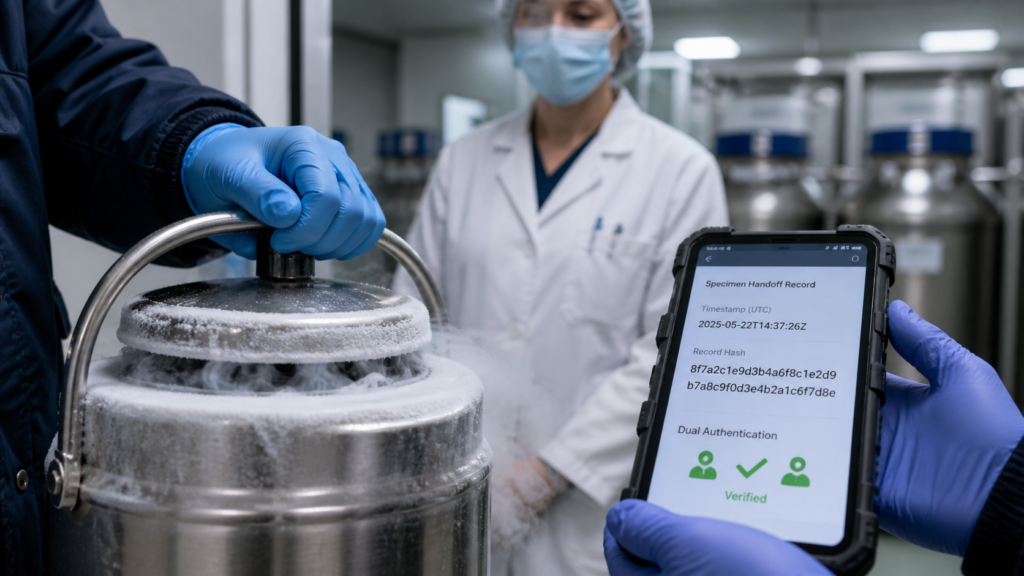
Compliance-grade chain of custody means immutable, hashed records at every handoff. It means dual-authentication at transfer points, so the system confirms both the sender and the receiver before custody transfers. It means automatic anomaly notification the moment a handoff deviates from protocol. It means records that hold up under FDA 21 CFR Part 1271 inspection without manual reconstruction.
Operators running IVF courier operations face this regulatory stack every day. FDA 21 CFR Part 1271, DOT/PHMSA hazmat handling, and HIPAA data protection. An immutable custodian audit trail is not a feature request. It is the architecture that makes the operation defensible.
Environmental Monitoring: Beyond GPS
Cold chain monitoring software that logs data after delivery is performing an autopsy. By the time you read the data logger, the specimen has already degraded. The clinic has already rejected it. The patient has already lost months of treatment.
Temperature Excursion Detection in Transit
Compliance-grade operations require continuous IoT telemetry streaming from the shipment during transit. Sensors report temperature, humidity, and shock data to the control system in real time. The system acts on excursions the moment they occur. A cryogenic integrity failure at -196°C detected in transit gives the operator a window to intervene. The same failure detected at delivery gives the operator a lawsuit.
Understanding cold chain logistics at this level separates operators who retain clinic contracts from those who lose them after a single incident.
Alert Fatigue and Dead Zone Coverage
Generic temperature alerts sent to every stakeholder create noise. Nobody acts because everybody assumes someone else will. Compliance-grade systems use role-specific escalation. The driver gets the first alert. If unacknowledged within a defined window, the dispatcher receives it. Then the operations manager. Edge computing handles cellular dead zones by storing telemetry locally and transmitting the moment connectivity resumes.

Regulatory Compliance: The Manual Paperwork Trap
The regulatory stack for medical courier operations spans four overlapping frameworks. HIPAA for patient data. FDA 21 CFR Part 1271 for human cells and tissues. DOT/PHMSA for hazardous materials transport. CLIA for laboratory testing standards. Most operators manage all four in spreadsheets and shared drives.
The failure pattern is predictable. A driver’s BBP certification expires on a Tuesday. Nobody catches it until the following Monday. That driver runs three specimen routes with a lapsed credential. One clinic audits the paperwork. Contract terminated.
Personal phone photos of patient labels are another silent risk. A driver photographs a specimen label for confirmation. That photo now contains protected health information on a personal, unencrypted device. It syncs to a personal cloud account. That is a HIPAA violation documented in the driver’s photo library.
Compliance-grade software automates credential verification against expiration dates and pre-departure compliance screening before route assignment. Expired cert on a regulated route triggers automatic lockout. The driver cannot receive the dispatch. The system generates audit-ready documentation on demand without manual assembly. Encrypted evidence capture replaces personal phone photos with a secured, access-controlled system.
How to Evaluate Medical Courier Software
Vendor demos show you the best version of every product. These eight questions expose the gaps between a demo and an operation that survives an FDA audit or a $199,188 lawsuit settlement.
- Does the system produce immutable chain of custody at every handoff, or only proof of delivery? Proof of delivery confirms arrival. Chain of custody confirms every custodian between pickup and delivery with hashed, tamper-evident records.
- Does environmental telemetry attach to the shipment, or only the vehicle? Vehicle-level GPS is a fleet management feature. Shipment-level temperature data is a compliance requirement.
- Does the system automate regulatory compliance, or require manual cert tracking? Ask to see what happens when a driver’s credential expires mid-shift.
- Does one encrypted channel connect dispatchers, drivers, clinics, and patients? Separate tools create PHI leak points at every handoff.
- Does the system calculate real-time profitability per route? Spreadsheet reconciliation after the billing cycle closes is not financial visibility.
- Does alert escalation follow role-specific rules, or does one alarm go to everyone? Generic alerts create alert fatigue. Role-specific escalation creates accountability.
- What is the deployment timeline: days, weeks, or months? A 90-day implementation means 90 days of continued manual risk exposure.
- What is the data security model? Ask specifically about encryption standards, access controls, and PHI isolation. Vague answers about “security best practices” are not answers.
Score each vendor against these eight criteria before scheduling a second demo. Any vendor that cannot answer question one with specifics does not belong in the medical courier software category.

How Truzer.ai Approaches Medical Courier Operations
Truzer.ai is a new entrant in this category, built on a different assumption than the current generation of medical courier tools.
The category problem is structural. Most tools bolt compliance features onto a dispatch engine. Dispatch works. Compliance breaks under pressure because it was never the foundation.
Truzer takes a different approach. The system builds a live digital twin of the entire operation called the ontology. The ontology maps every asset, route, driver, clinic, patient, regulation, and billable event into a single connected data structure. AI grounded in the ontology acts on real operational data, not generic training sets. Chain of custody is the architecture, not a feature added after launch.
For IVF and cryogenic transport, the ontology hard-codes -196°C thresholds, FDA 21 CFR Part 1271, DOT/PHMSA, and HIPAA rules. Every handoff is hashed, timestamped, and immutable. The system does not rely on driver compliance with manual protocols. It enforces protocols automatically.
Deployment takes 48 hours. No rip-and-replace of existing systems. Truzer connects to existing dispatch, ERP, telematics, and IoT sensors. AES-256 encryption at rest. TLS 1.3 in transit. Scoped tokens, role-based access control, isolated AI inference, and zero external API calls.
Truzer is new. This guide does not pretend otherwise. The approach is different because the assumption is different: compliance is the architecture, not the afterthought.