What is a digital twin?
A digital twin is a living, real-time digital replica of your entire company. Its operations, processes, data, and performance. It mirrors reality second by second. The twin takes all the truth about a business and gives access to it to the people who need it.
Operators care about a digital twin because it closes the gap between live state and the next decision. A real digital twin does not wait for a weekly report or a morning standup. It surfaces the ranked action, names the owner, and closes the loop before the exception becomes a customer call. This guide is for operations, supply chain, and technology leaders who need to understand the concept clearly before evaluating vendors or writing a business case.
Table of Contents
The Clearest Name for a Digital Twin: The Ontology
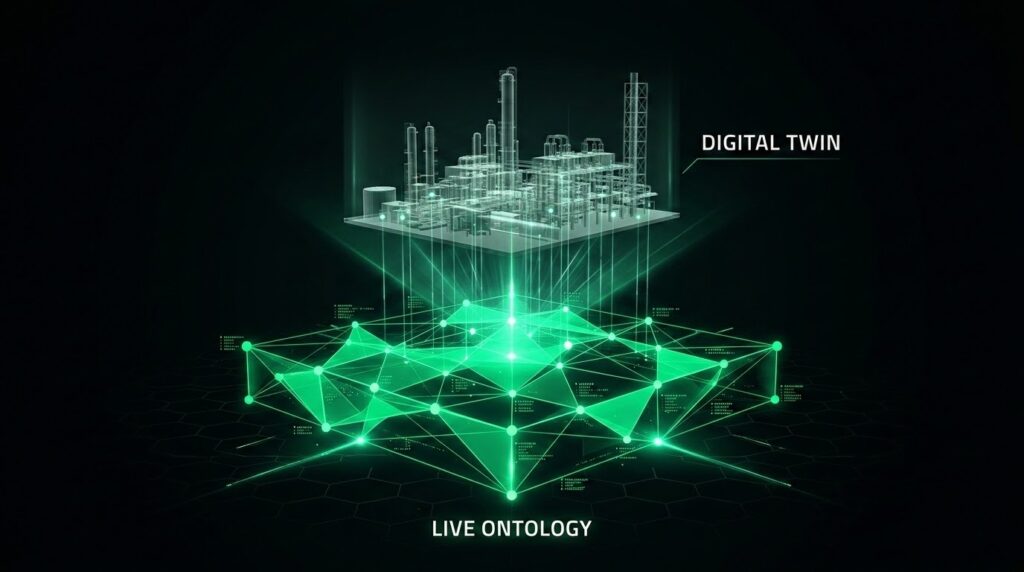
The ontology is the actual truth about everything in your business. Every entity, every relationship, every state, every constraint. A digital twin is how you give the people who need that truth access to it. Truth and access. Two halves of the same object.
For years, academic and vendor literature treated the ontology as a separate layer sitting underneath the digital twin. That framing is collapsing. The serious operators working on this problem have stopped calling them two different things. The Digital Twin Consortium’s formal definition describes a virtual representation synchronized with a real-world entity. That synchronization requires a shared vocabulary of things, how they relate, and what states they occupy. That vocabulary is the ontology.
Truzer calls its digital twin the ontology because that is the most honest name for what it actually is. One ontology, one operational truth, zero dashboard silos.
How a Digital Twin Works
Connect to the truth sources. The ontology ingests state from every system that holds operational truth. That means sensors on the floor, ERP, MES, WMS, EHR, SCADA, and any other system of record. In our experience building ontologies for operations teams, the first connector to go live is almost always undocumented. The truth sources that matter most live in spreadsheets, scheduler notes, and the heads of people who have run the operation for ten years. Each connector feeds live data into the model. No connector, no truth. The digital twin is only as real as its sources.
Build the live model. Entities, relationships, states, and constraints populate the ontology in real time. A trailer is not just a record in a TMS. It has a location, a temperature reading, a door-seal status, a scheduled yard window, and a relationship to the load it carries. The model holds all of that simultaneously and updates it continuously.
Act on ranked decisions. The ontology surfaces what needs to happen next. It does not produce a chart and wait for someone to interpret it. It produces a ranked action with an owner and a deadline. The dispatcher intervenes before the delay compounds. The maintenance lead intercepts the failure before the line stops. Decisions over dashboards.
The Four Types of Digital Twins
The industry recognizes four levels of digital twin scope. Each level models a different slice of the operational world. Understanding the hierarchy helps operators scope their deployments correctly.
| Type | What It Models | Example |
|---|---|---|
| Component twin | A single part | A bearing inside a wind turbine |
| Asset twin | A set of components working together | The whole turbine |
| System twin | A set of assets working together | The entire wind farm |
| Process twin | The work that runs across systems | Energy dispatch from farm to grid |
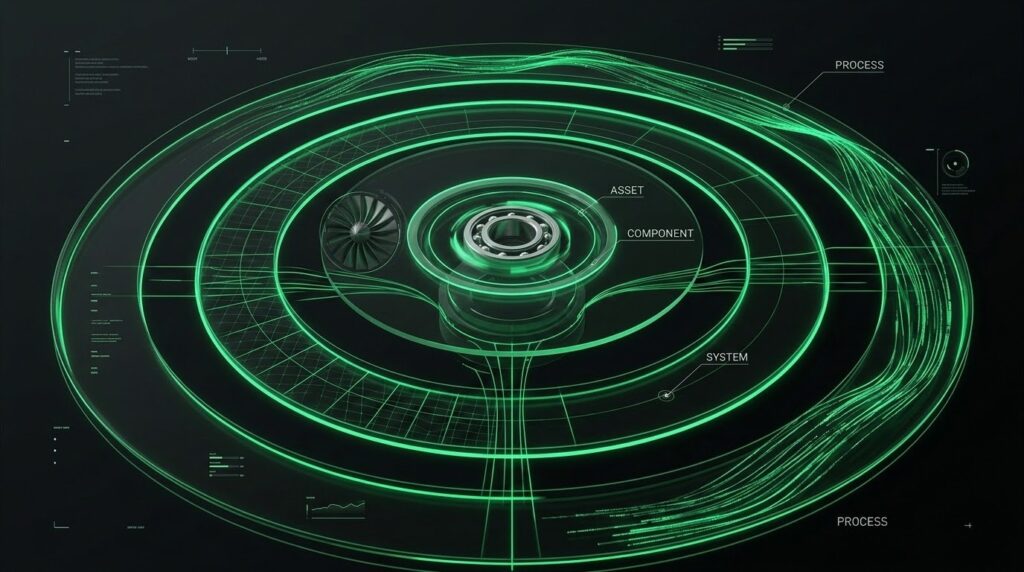
Most operators do not need four separate twins wired together with middleware. They need one ontology that contains all four levels. The component, asset, system, and process layers live as entities and relationships inside a single model. That is how a single control tower for your whole business becomes possible.
What a Digital Twin Is Not
Not a dashboard. A dashboard reports yesterday. A digital twin reflects the live state and tells operators what to do about it right now.
Not a simulation. A simulation runs a hypothetical scenario against a model. A digital twin is the real model in real time, continuously synchronized with the physical world.
Not a 3D rendering. The visual is downstream of the model. The model, the structured ontology of entities and states, is what matters. Strip the rendering away and the digital twin still works.
Not a BI tool. BI explains the past. A digital twin drives the next decision. If the output is a report that sits in someone’s inbox until Monday, it is not a digital twin.
Where Digital Twins Show Up in the Real World
Every industry below shares one pattern. The surface metrics look fine. The twin knows something the dashboard does not. It acts on that knowledge before the exception reaches the customer.
Manufacturing. The morning OEE report looks stable. The digital twin knows Line 3 starved twice on a feeder fault in the last shift. It reroutes the next batch to Line 1 and flags maintenance for the feeder. The output target holds. Without the digital twin, the plant manager reads about the miss in tomorrow’s production report.
Logistics and supply chain. A lane reads “on time” in the TMS. The digital twin knows the trailer missed its yard window by 40 minutes and the dock crew shifted to another load. It triggers the recovery plan and reassigns the dock slot. In time-critical logistics like IVF courier work or cold chain operations, that 40-minute gap is the difference between a viable shipment and a loss. McKinsey reports that digital twins applied to supply chain operations deliver typical results of up to a 20% improvement in fulfilling consumer promise, a 10% reduction in labor costs, and a 5% revenue uplift.
Healthcare. The ED looks fine on the board. The digital twin knows imaging is down in radiology and three patients are queued for CT. It redirects patient flow to the mobile unit and adjusts staffing ratios before the backup hits the waiting room. The charge nurse acts on a ranked decision, not a phone call from radiology 20 minutes too late.
Energy. The grid looks balanced. The digital twin knows a substation constraint changed after a transformer fault upstream. It adjusts dispatch priorities across three generating assets before the frequency deviation triggers automatic load shedding. The grid operator intervenes instead of reacting.
Construction and facilities. The schedule reads green. The digital twin knows a critical concrete pour slipped because the batch plant ran short on aggregate. It re-sequences the next two weeks of work, shifts the crane schedule, and notifies the steel subcontractor to hold delivery. The superintendent sees ranked decisions, not a red bar on a Gantt chart discovered at the weekly owner meeting.
Are Digital Twins a Form of AI?
Not exactly. A digital twin is the model of your operation. Artificial intelligence is what reasons on top of it. The two are different things, and the distinction matters.
Here is why. An AI without a digital twin has no connection to your specific business. It is trained on generic text from the public internet. Ask a generic large language model which valve on your plant floor is closest to failure and it will confidently name a valve that does not exist in your plant. It will recommend actions based on patterns from a thousand other plants that have no relationship to your equipment, your crew, or your maintenance history. Researchers call this hallucination. Operators call it a liability.
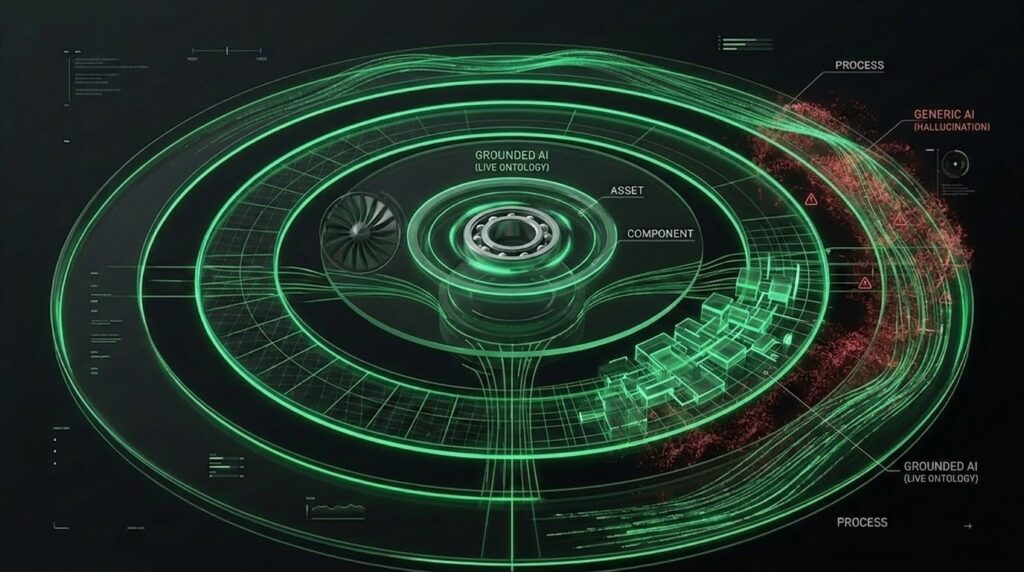
A digital twin fixes this by giving the AI a map of your actual operation to work from. Every entity, every sensor reading, every relationship, every current state. The AI no longer guesses. It reads the real state of your business and recommends actions tied to the real things in it. Every recommendation is grounded in your ontology, not hallucinated from generic training data. The digital twin constrains the AI to your reality. The AI finds the patterns inside that reality and surfaces ranked decisions. Neither piece works well alone. Together they close the loop between live state and action.
What Changes When a Real Digital Twin Is Working
When the digital twin holds live truth and the right people have access to it, the operation behaves differently. These are not benefits in the brochure sense. They are the observable changes that tell you the digital twin is doing its job.
- Faster interventions. The twin surfaces the exception before the customer calls. Response time drops from hours to minutes.
- Fewer surprises. Operators act on live state, not stale reports. The Monday morning fire drill disappears.
- Lower unplanned downtime. Maintenance gets ranked actions tied to real component state, not calendar-based guesses.
- Better decisions under pressure. When three things break at once, the digital twin ranks them. The operator acts on the highest-consequence item first.
- Closed-loop accountability. Every decision has an owner, a timestamp, and an outcome. The operational record writes itself.
The gap between intention and execution in this space is real. Grounded digital twins close that gap. They give AI a structured world to reason inside, not an open field to hallucinate across. The market reflects the urgency. Deloitte sizes the global digital twin market at roughly $13 billion in 2023, growing to $259 billion by 2032. That growth signals a shift from experimental pilots to core operational infrastructure.
How to Know You’re Looking at a Real Digital Twin
Not every product labeled “digital twin” earns the name. The real test is whether it holds live operational truth, not batch-loaded snapshots from last night’s ETL job. Whether it gives the right people ranked decisions with owners, not charts that require interpretation. Whether it is grounded in an ontology that AI can reason inside, or whether it is a reporting layer with a new name on it. The gap between a genuine twin and a relabeled dashboard is the gap between action and observation.
The Operating Principle
A digital twin exists to make the next decision obvious. The ontology holds the truth about your operation. The twin gives the right people access to that truth, second by second, and names the action, the owner, and the deadline. Everything else is decoration. All truth, no fiction. A digital twin is not a thing you watch. It is a thing that tells you what to do.